

What in the aftermarket will help us sustain next-generation mobility demands, finds out Ashish Bhatia.
After nearly 20 hours in transit, we landed at Automechanika Frankfurt 26. The wait was worth it! Greeted by clear blue skies, albeit a hotter-than-usual Europe forcing an early simulation of autumn hinted at by the leaf drop, made the task cut out. With AI’s economic impact grabbing the headlines alongside climate change and the West Asia conflict hitting oil prices and its derivatives, there was a looming gloom in sentiment, but a ray of optimism with exhibitors hoping to secure contracts as the global aftermarket sets out to achieve a common goal even if it is on different scales.
The automotive aftermarket is being asked to do more than keep vehicles on the road. It must now help workshops navigate electrification, make sense of increasingly software-dependent vehicles, support longer vehicle lifecycles and create new revenue streams from diagnostics, data and repairability. At the same time, the industry continues to depend on the fundamentals like reliable replacement parts, efficient workshop equipment, technical training and strong distribution networks.
Automechanika Frankfurt 2026 brought these parallel realities together. Held from September 08-12, the five-day event attracted more than 112,000 trade visitors from 173 countries, with 4,400 exhibitors representing 80 countries across approximately 300,000 sq. m. of exhibition space. Messe Frankfurt reported an increase in both exhibitors and visitors, reinforcing the event’s role as an international meeting point for the automotive aftermarket value chain. Around 66 per cent of visitors came from outside Germany, while the number of German trade visitors rose by 18.5 per cent compared with 2024.
New sources of growth
Messe Frankfurt’s pre-show assessment, drawing on Frost & Sullivan forecasts, projected global automotive aftermarket growth of 5.8 per cent in 2026. Longer vehicle service lives and the growing importance of the independent spare-parts market were identified as key drivers, alongside opportunities arising from electromobility, digitalisation and artificial intelligence. Geopolitical uncertainty and volatile supply chains remained important counterweights.
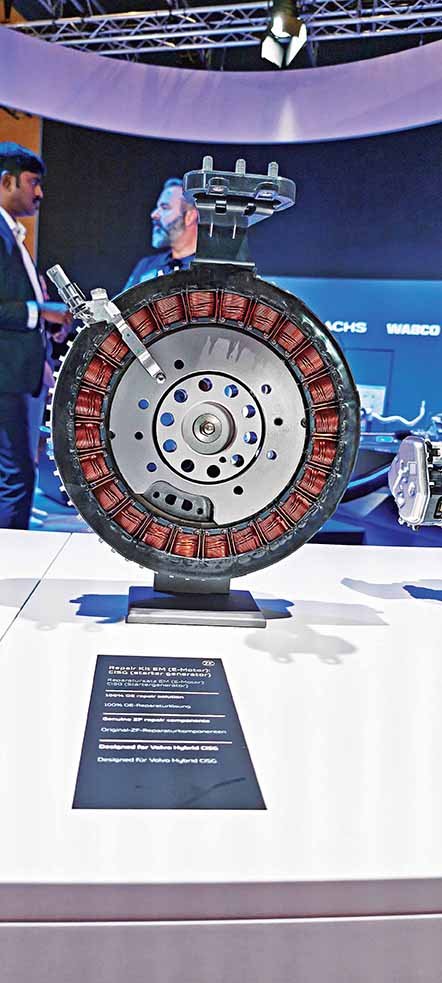
Repair Kit EM (E-Motor): CISG (starter generator)
The structural opportunity is clear. As vehicles remain in service for longer, the need for maintenance, replacement components and repair expertise persists even when new-vehicle demand is under pressure. Yet the composition of that demand is changing. Conventional mechanical repairs are increasingly sharing workshop space with electronics, diagnostics, connected systems and high-voltage technologies. Frost & Sullivan’s wider aftermarket analysis also points to an ageing global vehicle fleet, with the average age reaching approximately 12–13 years, and to a shift in value from parts supply towards predictive maintenance.
For emerging markets, these shifts need to be considered alongside the size and age of the vehicle parc, the growth of independent repair networks, affordability and access to technical capabilities. China’s expanding vehicle parc and rapid electric-vehicle adoption, for example, are creating a distinct aftermarket opportunity, while mature markets face the challenge of servicing increasingly complex vehicles already in circulation.
The strategic takeaway for suppliers is that aftermarket growth will not be uniform across geographies or product categories. Businesses will need to understand where vehicle populations are expanding, where older vehicles are staying on the road, and where electrification and digitalisation are changing the nature of service demand. For India and other developing markets, this makes localisation, distribution reach, affordability and workshop capability as important as the introduction of new technologies.
Tier-one suppliers rethink their aftermarket identities
One of the clearest themes at Frankfurt was the repositioning of established component suppliers. Their engineering heritage remains important, but the customer proposition is broadening from individual products towards integrated portfolios, repair solutions, technical support and digital services.
ZF Aftermarket
ZF Aftermarket’s presence at Automechanika Frankfurt reflected a wider shift in the business, moving beyond the supply of replacement components towards an integrated proposition built around workshop productivity, digital diagnostics and vehicle uptime. The company’s approach brings together its parts portfolio, technical expertise, connected services and repair solutions to support workshops dealing with an increasingly complex vehicle parc.
A key part of this strategy is the integration of vehicle data into workshop workflows. ZF Bus Connect, for instance, can feed vehicle CAN data into ZF [pro]Diagnostics, helping workshops connect remote vehicle information with diagnostic processes. The wider digital ecosystem is designed to help fleet operators and workshops identify faults earlier, make maintenance decisions with better information and reduce avoidable downtime. For commercial vehicles, where availability directly affects operating economics, the value proposition extends beyond the component to the time a vehicle spends off the road.
ZF’s commercial vehicle focus was particularly relevant through its connected fleet and workshop solutions. The company showcased ZF Bus Connect and SCALAR Asset Insights, both nominated for the 2026 Automechanika Innovation Awards. The former connects vehicle data with diagnostic and maintenance workflows, while the latter supports fleet visibility and asset management. Together, they illustrate how ZF is seeking to connect workshop-level diagnosis with the larger business priority of keeping commercial vehicles productive.
The digital push also extends to workshop administration. ZF [pro]Manager is designed to manage customer communications, bookings and job progress, reducing the administrative burden on workshops and freeing up time for repair work. The direction is towards a connected workflow in which vehicle information, diagnostics, parts procurement and customer interaction become fragmented.
Alongside digitalisation, ZF’s braking portfolio highlighted the growing importance of environmental performance in conventional replacement components. TRW DTEC brake pads and discs were presented as a lower-particulate solution, with the company reporting up to 80 per cent lower PM10 emissions in brake dynamometer testing compared with conventional combinations. ZF also highlighted recycled TRW DOT 4 ESP brake fluid incorporating post-consumer recycled material. These developments show how sustainability can extend to the maintenance of vehicles already on the road, rather than being confined to new-vehicle powertrains.
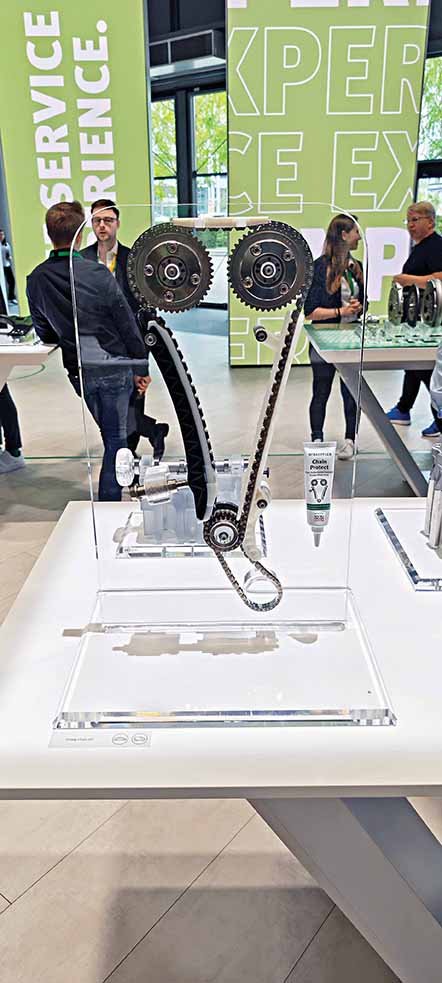
Timing Chain Kit
Another strategic priority is servicing the growing presence of Chinese vehicle brands in Europe. ZF Aftermarket has outlined plans to expand its coverage of these vehicles, reflecting the need for independent workshops to access suitable parts and repair solutions as the market evolves. This is a practical extension of its broader strategy. Vehicle parc changes create aftermarket opportunities only when parts availability, technical information and workshop capability keep pace.
Schaeffler’s One Brand, A Wider Lifecycle Proposition
Schaeffler Vehicle Lifetime Solutions (VLS) presented a strategy built around a unified brand, integrated portfolio and consistent service experience. The change is particularly visible in the planned transition of its established product brands LuK, INA and FAG towards a more unified customer-facing presence under the Schaeffler name. The product brands have long carried strong recognition in their respective categories. The consolidation aims to make the wider portfolio and the company’s lifecycle proposition more visible to customers.
This is more than a packaging exercise. Schaeffler VLS is positioning itself beyond the supply of clutch, transmission, engine and chassis-related components. Its stated direction combines mechanical, electronic and software-enabled repair solutions with workshop services, digital platforms, training and data-based offerings. REPXPERT remains part of that workshop-support ecosystem, providing technical information, training, hotlines, repair guidance and special tools.
The integration of Vitesco Technologies under the Schaeffler umbrella also expands the group’s ability to connect original-equipment engineering with aftermarket requirements across conventional, hybrid and electrified vehicles. The commercial logic is to help workshops manage a wider range of repair needs through one connected supplier relationship rather than navigating a collection of disconnected products and services. The challenge will be to translate that breadth into practical value at distributor and workshop level. Brand consolidation can simplify recognition, but the real test is whether customers can identify the right part, access the required technical information and complete repairs efficiently.
AUMOVIO Brings ATE And VDO Into A New Aftermarket Entity
Another important structural development was the presence of AUMOVIO Aftermarket, the business established following the spin-off of Continental’s automotive activities in September 2025. At Frankfurt, AUMOVIO’s independent aftermarket proposition brought together two familiar names. ATE, with its braking expertise, and VDO, with its electronics and mechatronics portfolio.
For VDO, the show marked a return to the aftermarket spotlight after a period away from Automechanika. Its portfolio spans replacement parts and electronics, while its new battery offering extends the brand into another workshop-relevant category. The batteries are positioned as OE-quality products made in Europe, with a focus on reliable energy supply for modern vehicle architectures.
ATE, meanwhile, continues to build on its braking heritage with products and support for independent workshops. The exhibitor listing highlighted the ATE MK 100 ABS/ESP brake-control system as an aftermarket proposition, combining a hydraulic control unit with an electronic control unit supplied from original-equipment production. AUMOVIO also presented remote technical support, allowing specialists to view a vehicle-related problem through a workshop technician’s smartphone or tablet and use visual guidance to assist diagnosis.
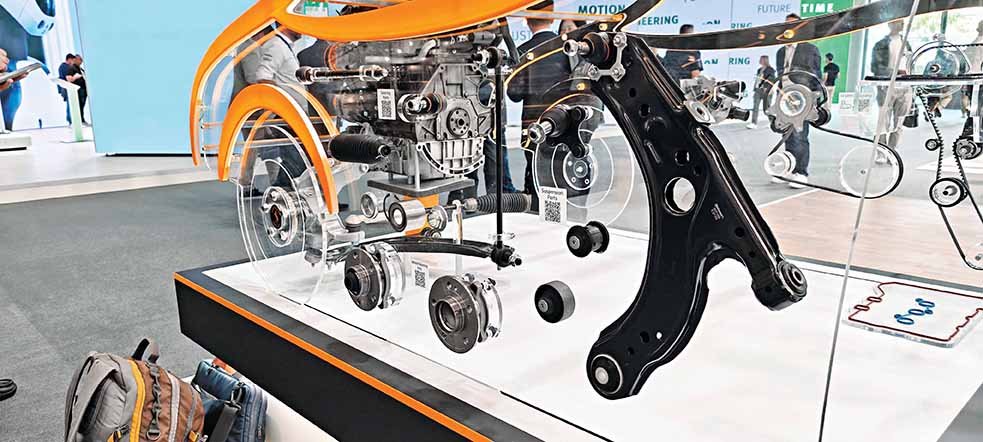
These developments underline how a new corporate identity can bring established product expertise together while giving workshops a broader support structure. For distributors, the opportunity lies in a more integrated portfolio. For repairers, it is about access to suitable parts, diagnostic knowledge and assistance when conventional repair procedures are no longer sufficient.
The wider pattern points to how the independent aftermarket remains a market of trusted product brands, but the companies behind them are increasingly organising around lifecycle support and the complexity of the modern vehicle.
BorgWarner Is Connecting Propulsion Technology With The Aftermarket
BorgWarner’s Frankfurt presence illustrated the breadth of the transition. Its aftermarket portfolio continues to serve vehicles powered by conventional propulsion systems while drawing on the company’s wider expertise in electrification and drivetrain technologies. The company’s One BorgWarner Aftermarket approach sought to bring its customer proposition together across categories that include turbocharging, exhaust-gas management, transmission and drivetrain systems, thermal management, ignition and diesel cold-start technologies. The display also included electrification-related hardware, including an integrated drive module, an S-winding stator, an electric torque-vectoring disconnect and an 800V silicon-carbide inverter featuring BorgWarner’s Viper power module.
The combination is relevant because the aftermarket’s transition is not a simple switch from combustion engines to electric vehicles. The existing vehicle parc will continue to require established repair categories, while new vehicle architectures create demand for different technical knowledge, replacement components and service processes.
BorgWarner’s approach reflects that dual requirement of supporting the current parc while preparing the aftermarket for new propulsion systems. Its announced programme of more than 800 new products during 2026 also points to the importance of catalogue breadth and application coverage in an increasingly competitive replacement-parts market.
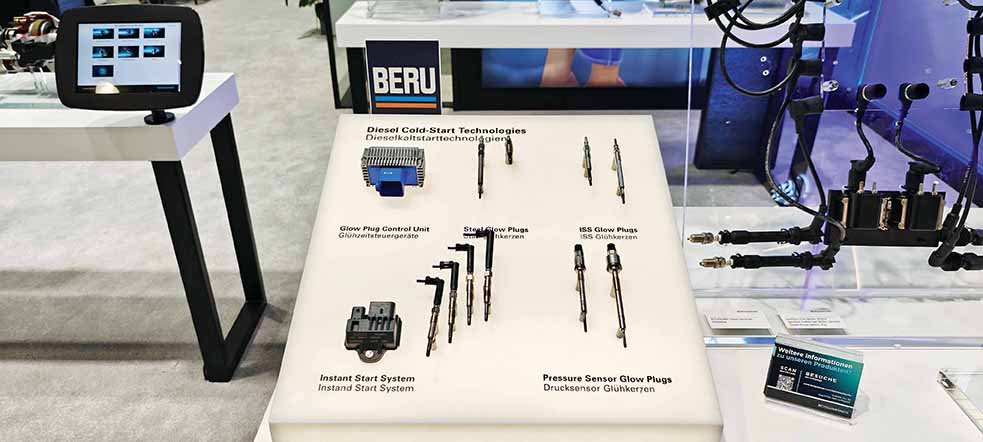
The commercial question is how suppliers can make their engineering capabilities relevant across different powertrains without complicating the customer experience. For distributors and workshops, a coherent portfolio can be valuable only if it is backed by clear application data, availability and technical support.
The workshop itself is becoming a technology investment
Built on the value proposition communicated in 2024, the transformation of the vehicle is also changing the economics of workshop equipment. Commercial vehicles are heavier, increasingly electrified and equipped with more complex systems, while workshop operators remain under pressure to improve turnaround times and maximise the use of available floor space.
Stertil-Koni’s heavy-duty lifting equipment offered a practical view of this shift. Its wireless mobile column lifts are designed for trucks, buses, truck-trailer combinations and other heavy vehicles, with capacities ranging from 6,500 kg to 17,500 kg per column. Up to 32 columns can operate together in a synchronised configuration without interconnecting cables.
That flexibility matters in workshops handling a mix of vehicle types and axle configurations. Mobile columns can be repositioned as requirements change, without the fixed civil works associated with some lifting installations. Safety features listed by the company include drive-away protection, mechanical locking, overload protection and individual emergency stops. Its EARTHLIFT regenerative versions are designed to provide longer lifting cycles and reduce charging requirements.
For India, where commercial vehicle uptime is a direct operational concern for fleet owners and service networks, workshop investment has to be justified by productivity, safety, serviceability and lifecycle cost. Demand from OEM-linked workshops and the requirements of manufacturers such as Tata Motors and Ashok Leyland are relevant to that wider market context. The broader lesson is that workshop equipment is part of the capability required to maintain the next generation of trucks and buses.
Classic cars heritage as a professional aftermarket opportunity
Frankfurt also looked back to understand another part of the vehicle lifecycle. Hall 11.1 hosted a dedicated classic-car programme again, combining specialist knowledge, networking and live experiences. The Classic Car Exhibition featured vehicles from Opel Classic, while the programme included a discussion with FIVA on business opportunities in the international historic-vehicle and youngtimer market.
The Classic Alliance, developed with Bosch Classic, DAT, Eucon, ROWE and FIVA, brought together organisations with expertise in components, vehicle data, specialist knowledge and the professional handling of historic vehicles. The initiative is intended to connect businesses and specialists serving this segment rather than treating classic vehicles solely as collector interests.
CEO Breakfast collaboration becomes a business imperative
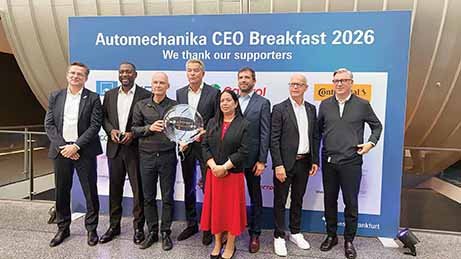
The third Automechanika Frankfurt CEO Breakfast brought an executive-level perspective to the transformation underway across mobility and the supplier industry. The event opened with a fireside chat featuring Dr Bertrand Piccard, the explorer, innovator and sustainability pioneer known for the Solar Impulse project, which demonstrated the potential of solar-powered aviation. The session was followed by a CEO Talk involving representatives from AUMOVIO, Castrol, Continental, MANN+HUMMEL, Schaeffler and ZF.
Piccard’s experience provided a wider frame for the discussion. Established industries often need to challenge assumptions about what is technically possible and commercially viable. For the automotive aftermarket, sustainability and innovation are not limited to developing a new component. They also involve improving repairability, extending product life, reducing waste and making the service ecosystem more efficient.
The executive contributions highlighted different dimensions of the same transition. Schaeffler VLS emphasised repairability and simplifying the customer experience through an integrated portfolio and service proposition. AUMOVIO pointed to collaboration between industry, workshops and business partners as a requirement for navigating market change. MANN+HUMMEL’s message linked materials expertise and a data-driven supply chain with the need for more sustainable, future-ready solutions. Castrol highlighted innovation, collaboration and sustainable progress as central to the future of mobility. ACI