

Busworld Southeast Asia 2026 showcased Indonesia’s focus on firm net-zero targets and push for deeper localisation in a phased manner, writes Richa Tyagi.
The fourth Busworld Southeast Asia, held from May 20-22, 2026, once again confirmed why Jakarta refuses to give in to the buzz around the new capital, just yet! It is becoming an increasingly important meeting place for the bus and coach industry in ASEAN. The bus and coach fair brought together 47 exhibitors from nine countries and welcomed 5,133 registered visitors from 41 countries. Covering approximately 8,000 sq. m., in comparison to 6,500 sq. m. last time around, the event featured 25 vehicles on display and provided a comprehensive overview of the trends shaping people-movers-led public transportation across the region. Reflecting on the event, Vincent Dewaele, General Manager of Busworld International, noted the growing international character of the exhibition and the increasing interest from overseas participants. The 2026 edition demonstrated both the strength of Indonesia’s bus manufacturing ecosystem and the broader growth potential of the Southeast Asian market. As investment in electrification, local manufacturing and mobility innovation continues, Busworld Southeast Asia is expected to play an increasingly important role as a meeting point for the region’s bus and coach industry.
The importance of Indonesia’s automotive sector was reflected in figures presented by the Ministry of Industry on the sidelines of the trade fair. The non-oil and gas manufacturing sector, one of the country’s primary economic drivers, recorded growth of 5.17 per cent in 2025 and contributed 19.07 per cent to national GDP. The sector employed 20.5 million people, accounted for 37.73 per cent of total investment and generated 80.27 per cent of Indonesia’s exports. Industrial confidence remained positive, with the Industrial Confidence Index reaching 51.75 in April 2026. The automotive industry continues to be a major contributor to this performance. Indonesia currently operates 41 four-wheel vehicle manufacturing plants with a combined production capacity of 2.59 million units annually, alongside 82 two- and three-wheel vehicle manufacturing facilities with a combined capacity of 11.2 million units per year. The industry directly employs nearly 100,000 workers and has attracted investment exceeding Rp 194 trillion. Commercial vehicles remain an important segment of the industry. National production reached 164,078 units in 2025, while wholesale sales totalled 164,024 units. Although volumes have moderated from the post-pandemic peak recorded in 2022, Indonesia continues to represent one of the largest commercial vehicle markets in Southeast Asia, focused on protecting its domestic industry’s interests.
Indonesia remains one of the most significant markets in Southeast Asia’s bus and coach industry. The country combines strong domestic demand with a well-regarded bodybuilder ecosystem known to play a central role in vehicle development and customisation. Indonesia operates largely through a chassis-bodybuilder model, allowing manufacturers and operators to tailor vehicles to local operating conditions and customer requirements. This structure has encouraged international manufacturers to work closely with Indonesian partners that possess extensive market knowledge and established customer networks. The call for contract manufacturing and custom offerings has only grown louder.
Electrification was one of the dominant themes throughout the exhibition. New entrants and established players alike demonstrated the growing momentum behind battery-electric mobility in Indonesia and across Southeast Asia. According to data presented by the Ministry of Industry, Indonesia’s electric vehicle assembly industry has attracted a total investment of Rp 30.424 trillion. The sector currently includes nine electric bus manufacturers with a combined production capacity of 6,300 units per year. The national electric bus industry has become an increasingly important part of Indonesia’s industrial strategy. Nine domestic manufacturers are currently active in battery-electric bus production, supported by investments totalling Rp 5.136 trillion. Several locally assembled models have already achieved domestic content levels above 40 per cent, including products manufactured by PT VKTR Sakti Industries, PT Mobil Anak Bangsa (MAB) and PT Wintrone Orions Indonesia. Government policy continues to support further localisation. Under the Ministry of Industry’s KBLBB roadmap, EVs must achieve minimum domestic content levels of 40 per cent through 2026, increasing to 60 per cent during 2027–2029 and reaching 80 per cent from 2030 onward. The roadmap is intended to encourage domestic production of battery modules, battery packs and eventually battery cells, creating a more integrated electric vehicle supply chain within Indonesia.
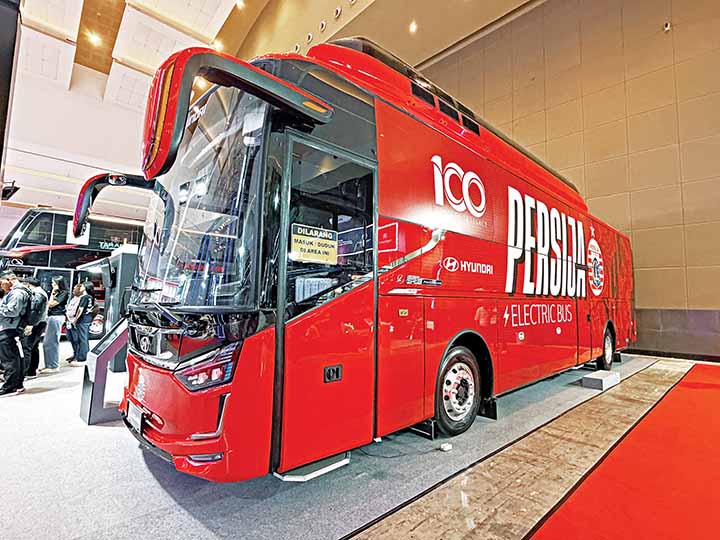
The exhibition itself reflected this transition. INVI attracted attention through the introduction of Higer buses to the Indonesian market, while SAG presented Golden Dragon products. Both companies demonstrated the growing presence of Chinese bus manufacturers throughout the region. One of the most discussed vehicles at the event was Laksana’s new electric coach developed for Persija Jakarta. The Legacy SR3 Neo Panorama, built on a Hyundai Elec City chassis, will become the first fully electric official team bus for an Indonesian football club.
Several first-time exhibitors used Busworld Southeast Asia as a platform to expand their visibility in both domestic and international markets. Trijaya Union, an Indonesian bodybuilder established in 1978, introduced the Neo Grantour and Triun MX while also presenting the premium Triun CX microbus aimed at the growing tourism sector. Piala Mas also made its debut at the exhibition. The company attracted attention among Indonesia’s established bodybuilders by showcasing its latest developments. MAN Truck & Bus made its debut at Busworld Southeast Asia with a clear focus on chassis solutions and cooperation with Indonesian bodybuilders. Together with local partner PT Millennium Inframach Distribusi Indonesia, the company highlighted the value of local expertise and established customer relationships.
SONGZ
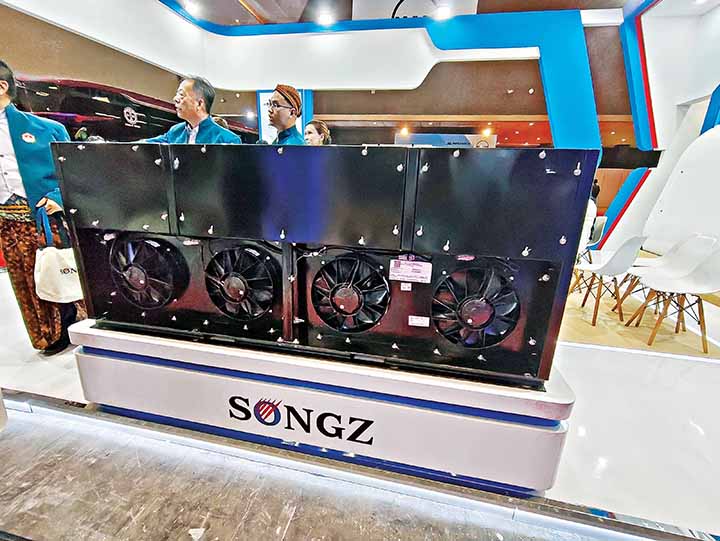 SONGZ highlighted its leadership in electric bus air-conditioning technology and its growing global footprint, across Southeast Asia, India, Latin America, and the Middle East. Speaking at the exhibition, Shawn Lui, General Manager of SONGZ International Trading Co., Ltd., introduced the Shanghai-based company as a specialist in bus HVAC systems with more than 20 years of experience in electric bus air conditioners. At the show, SONGZ highlighted its strong presence in Indonesia, where the company first entered the market in 2008. Today, the company supplies air-conditioning systems to nearly all major bus manufacturers in the country. Lui noted that SONGZ currently holds around 94 per cent market share in Indonesia’s electric bus air-conditioning segment, while its diesel bus air-conditioning market share stands at approximately 30 per cent. A major technology focus at the show was SONGZ’s newly developed R290 propane refrigerant bus air-conditioning system. Designed to reduce CO₂ emissions, the system has completed long-term operational testing and is now ready for commercialisation. Lui also highlighted the company’s recent international expansion efforts, including its entry into the Indian market and cooperation with Egypt’s leading bus manufacturer. He added that Brazil has become another major success story for the company, where SONGZ now claims a 94 per cent market share. Discussing India, Lui said the company aims to achieve a 20 per cent market share within the next five years, focusing primarily on electric bus solutions as India accelerates its transition toward electrified public transportation.
PT Simnu
 At Busworld Southeast Asia 2026, PT Simnu showcased its latest synthetic leather solutions for the public transportation sector, highlighting products developed for buses, trains, and passenger vehicles. At the exhibition, company launched a new product Bolzano Altera, a new synthetic leather designed specifically for public transport seating. Featuring a thickness of 1.4 mm, the material is engineered to meet the durability requirements of high-traffic transit environments. Bolzano Altera introduces a distinctive wood-grain texture, offering an alternative to conventional Napa finishes commonly used in vehicle interiors. The company also displayed examples of seating materials supplied to customers in the bus, rail, and passenger vehicle sectors, demonstrating its capabilities in developing upholstery solutions for demanding transport environments.
Pertamina Lubricants
 Pertamina Lubricants presented its lubricant solutions for the transportation and commercial vehicle sector. As part of the state-owned Pertamina Group, the company showcased its integrated operations, covering base oil production, lubricant manufacturing, and distribution. The company serves a wide range of industries, including transportation, mining, steel, marine, and defense. At the exhibition, Pertamina Lubricants introduced products developed with advanced additive technology sourced from leading global suppliers, alongside its extensive distribution network across Indonesia and growing international presence.
PT Adiputro Wirasejati
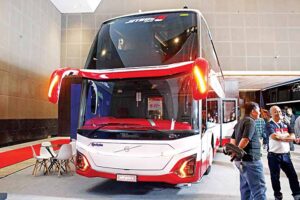 At Busworld Southeast Asia 2026, Indonesian coachbuilder PT Adiputro Wirasejati showcased a broad lineup of its bus portfolio, ranging from high-decker coaches to double-decker models. It displayed the Jetbus 5 double-decker, Bagong Jetbus 5 Dream Coach, and Jetbus 5 Series portfolio. Speaking at the exhibition, Jesse Jethrokusumo, President, explained that the company operates two production lines at Malang, East Java, Indonesia: one dedicated to microbuses and commercial vans, and another focused on large buses from 8m to 13.5m. One of the key highlights at the fair was a dual-class sleeper bus concept that combines the conventional seating of a 2-by-1 layout with 18 sleeper berths. “Operators wanted to offer something similar to airlines, with two classes in one bus,” Jesse explained. Targeting both short- and long-distance intercity operations. On the electrification front, the company confirmed it has already developed a prototype electric city bus in collaboration with Korean manufacturer KG Mobility, currently undergoing trials in Jakarta. Beyond buses, Adiputro is also expanding into refrigerated and aluminium box trucks, leveraging its in-house manufacturing capabilities in fibre components and ABS plastics to diversify its commercial vehicle portfolio.
New Armada
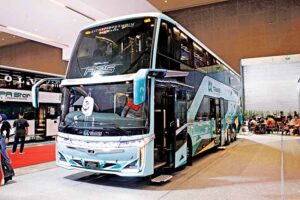 New Armada, one of Indonesia’s oldest and most established bus body manufacturers, showcased its latest innovations. The company’s four display units drew attention to its diverse coach portfolio: Skylander R25 DD, Touristo F25, Skylander F25 and Skylander R25 Luxury. A major attraction at the exhibition was New Armada’s latest double-decker coach iteration of the Skylander R25. The new 12.8m Skylander R25 represents the latest generation of New Armada’s luxury long-distance coaches, designed for routes of up to 700 kilometres with a strong focus on comfort, safety, and passenger experience. It is built on the MAN Lion’s Chassis CO RR4 26.480 Euro 5 platform. The RR4 26.480 uses a MAN D26 12.4-litre diesel engine producing 480 hp (353 kW). This features a full double-deck layout, premium seating, AVOD entertainment, USB charging, and sleeper-class accommodations. Some models featured large luggage compartments typical of the market, capable of carrying motorcycles, a practical solution for Indonesia’s intercity transport market. Tommy Lumadjeng, Marketing Director of New Armada, also discussed its ongoing work in electric mobility. While the company has already developed electric buses, adoption remains limited due to Indonesia’s still-developing charging infrastructure outside major cities.
PT Tentrem Sejahtera
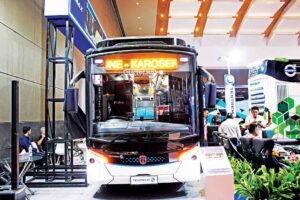 At Busworld Southeast Asia 2026, Yohan Wahyudi, Director of PT Tentrem Sejahtera, highlighted the Indonesian coachbuilder’s latest innovations and its vision for the future of public transportation. The company, based in Malang, Indonesia, showcased three vehicles representing different segments of the market: Avante D2 / H8 Grand Captain Double Decker, Avante H8, and Avante H7 Electric. The first was a premium double-decker coach built on a Volvo B11R chassis with an I-Shift gearbox, a 450hp Euro 5 Volvo D11C450 engine. Designed for long-distance intercity travel, the bus features six sleeper compartments on the lower deck and seating for 28 passengers on the upper deck, catering to routes of up to 500 km and travel times of around 12 hours. The second exhibit was a single-decker coach on a Mercedes-Benz chassis powered by a six-cylinder, 260 hp Euro 4 OM 926 LA Diesel engine. The third exhibit was a fully electric, wheelchair-accessible medium city bus. Equipped with a 132 kWh battery pack, the bus offers a range of nearly 200 km and accommodates approximately 16 passengers. Designed as a prototype, it features doors on both sides, enabling operation with either left- or right-side boarding infrastructure. Wahyudi noted that Indonesia’s bus market is becoming increasingly focused on passenger comfort and safety, driving demand for technologies such as ADAS, driver monitoring systems, and onboard CCTV.
Laksana
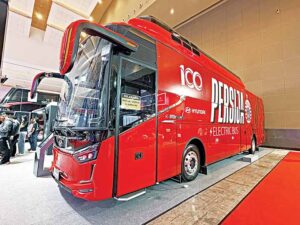 PT Laksana Bus Manufaktur presented three new vehicles at Busworld Southeast Asia 2026, including two electric buses and a premium double-decker coach. Speaking at the exhibition, Stefan Arman, Technical Director of PT Laksana Bus Manufaktur, said Busworld continues to be an important platform for the company’s international outreach. Among the vehicles on display was a 12m electric sports coach developed in collaboration with the Hyundai Elec City chassis. Based on Laksana’s 12m Legacy SR3 Neo Panorama body, the bus was built for Persija Jakarta and is among Indonesia’s first electric coaches designed specifically for sports team transportation. The vehicle features a stainless-steel frame combined with aluminium body panels to reduce weight while maintaining durability. According to Arman, the lightweight construction helps meet Indonesia’s strict vehicle weight regulations. The coach is equipped with a 290.4 kWh battery capacity and offers a driving range of around 300 km. Laksana also exhibited an eight-metre electric bus developed with the Chinese manufacturer Skywell. The vehicle follows specifications used in Jakarta’s electric public transport ecosystem, where authorities are pursuing an ambitious transition towards electric mobility. The company’s third exhibit was a highly customised 13.5m double-decker coach developed with operator Juragan 99. Designed for premium intercity travel, the bus is powered by a 449 hp Mercedes-Benz O 500 RSD 2445. It accommodates only 29 passengers and incorporates several private cabins.
PT Piala Mas
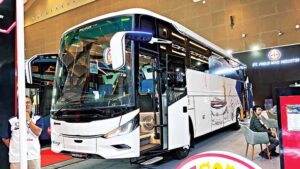 PT Piala Mas Industry, an Indonesian bus body manufacturer based in East Java, presented its latest coach designs aimed at the long-distance passenger transport market. Speaking at the exhibition, Bryan Soedjoko, Director, introduced two of the company’s flagship products. The first is a Rexus 8S 12m coach powered by a Hino RM 280 chassis/engine package engine with a peak rated 280 hp, developed for Indonesia’s intercity and interprovincial (AKAP) sector. It is expected to serve routes that can extend beyond 1,000 kilometres and, in some cases, connect Indonesia with neighbouring Malaysia and Brunei Darussalam. Designed with a focus on passenger comfort, safety and contemporary styling, the coach represents the company’s direction towards more modern and premium transport solutions. Also on display was the 13m Rexus 8D Commander, a high-deck coach powered by a 260 hp engine developed primarily for operators serving long-distance routes across Sumatra, including services between Jakarta and Aceh. The model features a double-glass front design and a distinctive interior layout incorporating sleeper seating above the driver’s compartment, providing an airline-inspired travel experience for passengers on extended journeys. Established in 1978, PT Piala Mas Industry manufactures a wide range of passenger transport bodies, including intercity coaches, city buses, government vehicles, military transport buses and microbuses. The company produced approximately 700 units in 2025 across its various product segments. In addition to conventional bus bodies, it also supplies passenger bodies mounted on truck chassis.
SAG Golden Dragon
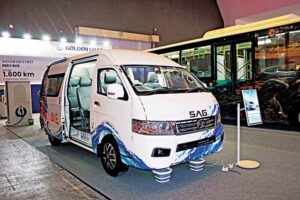 SAG Golden Dragon presented two new vehicle solutions: the XML6549JEV electric van and the 12 M high-deck electric bus aimed at supporting Indonesia’s transition toward lower-emission public transportation while addressing the realities of the country’s infrastructure landscape. SAG Golden Dragon, the partnership between Chinese bus manufacturer Golden Dragon and its official Indonesian distributor, PT. Sinar Armada Globalindo (SAG) unveiled the SAG Max 5.44m electric van with a 440 km range and also showcased a 12m high deck electric bus with a 250 km range. Speaking at the exhibition, Djoko Purwanto, Technical Director of SAG, outlined the company’s journey with Golden Dragon since 2018. The collaboration began through Jakarta’s TransJakarta electrification programme. Today, 112 Golden Dragon electric buses are operating within the TransJakarta fleet, with additional vehicles serving other regions. Golden Dragon also secured the Best E-Bus Design award at the event with its XML6549JEV electric van, which features a 100 kWh battery pack and a claimed driving range of up to 440 km. It supports one-hour fast charging and accommodates up to 16 passengers. SAG Golden Dragon also showcased a 12M high-deck electric bus with a 250 km range. The brand further unveiled its future REEV highway coach project, which delivers a maximum range of 1600 km with a diesel engine serving as a generator, targeting long-distance transportation scenarios across Southeast Asia. The concept allows the bus to operate on electric power while using an onboard generator to extend range when charging facilities are unavailable. According to SAG, the full road testing is still underway. Initial trials are scheduled to begin in Indonesia following homologation, with commercial deployment targeted by the end of 2026.
Trijaya Union
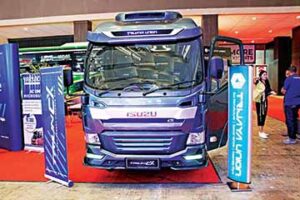 At Busworld Southeast Asia 2026 in Jakarta, Trijaya Union presented its latest range of passenger transport solutions. Founded in 1978, the Indonesian bus body builder is approaching five decades in the industry and continues to expand its portfolio to meet evolving market demands. Speaking at the event, Dhimas Yuniarso, President Director, Trijaya Union, said the company has been concentrating on vehicles ranging from six to 8.5m, while continuing to offer 12m buses for selected applications. The company showcased three products at the exhibition: the Neo Grantour microbus, the all-new Triun CX microbus, and the Triun MX medium bus. The Neo Grantour, one of Trijaya Union’s best-selling models in Indonesia, is available on Mitsubishi Fuso, Isuzu and Hino chassis platforms. Although introduced a year ago, the vehicle continues to receive refinements aimed at improving comfort, quality and overall performance. Making its debut at the show, the Triun CX is a new 19+D-configuration microbus built on an Isuzu chassis. Completing the display was the Triun MX medium bus, featuring a distinctive design language and representing the next generation of Trijaya Union’s medium-duty product range. Beyond its exhibition lineup, the company reported producing approximately 500 buses in 2025. Including special-purpose vehicles, the total output reached around 800 units. Trijaya Union has also entered the electric vehicle segment, recently delivering its first batch of electric buses while developing lightweight body structures to meet vehicle weight requirements and operational standards.
MAN Truck & Bus
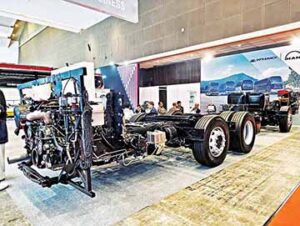 MAN Truck & Bus marked a significant presence at the event by displaying its chassis architecture. The exhibit underlined MAN’s renewed commitment to the Indonesian and wider Southeast Asian markets through its partnership with local importer Inframach. According to Roland Kopp, Head of Chassis Bus, MAN Truck & Bus SE, displaying the chassis allows operators, bodybuilders and fleet owners to gain a better understanding of the technical features that underpin vehicle performance, durability and operating efficiency. The centrepiece of MAN’s display was its RR4 chassis, developed for demanding long-distance coach operations. Designed for double-decker applications, the platform is suited to Indonesia’s expanding toll road network, where vehicles regularly accumulate annual mileage of 300,000 to 350,000 kilometres. Manufactured at MAN’s facility in Starachowice, Poland, the chassis forms part of the company’s global product portfolio. The platform can be configured with a range of fuel tank capacities, suspension systems and layout options, enabling bodybuilders to tailor vehicles to specific operational requirements. MAN also highlighted its broader chassis portfolio, which includes low-floor solutions for public transport as well as electric and hybrid-electric platforms. While electrification in Southeast Asia remains at an early stage, the company sees opportunities emerging through government-supported public transport initiatives and continues to evaluate future EV deployment in the region.