

Industry targets $200 billion by 2030 as OEM supplies grow 16.3%, exports reach $24 billion and battery localisation accelerates
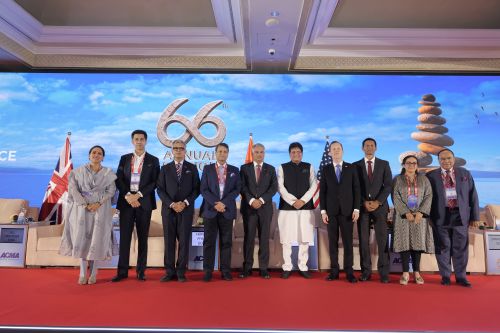
The Automotive Component Manufacturers Association of India (ACMA) Mobility Foundation today hosted its 66th Annual General Meeting under the theme “Beyond Resilience”, bringing together policymakers, automotive industry leaders, global stakeholders and thought leaders to discuss the next phase of growth for India’s auto component industry.
With the sector targeting a $200 billion industry by 2030, discussions focused on how India can move beyond resilience and strengthen its position as a globally competitive manufacturing and sourcing hub.
India’s auto component industry recorded a turnover of ₹7.6 lakh crore ($85.9 billion) in FY26, registering a 12.7% year-on-year growth. Having doubled its market size over the past five years, the industry is now looking to build on this momentum through higher exports, deeper localisation, technology adoption and greater integration with global supply chains.
The industry’s optimism was reflected in the ACMA-BCG report, ‘Beyond Resilience,’ released during the session. Around 90% of auto component manufacturers surveyed across large, medium and small enterprises said they were “in the right place at the right time,” highlighting confidence in India’s growth prospects and its increasing relevance in global automotive supply chains.
The sector’s exports reached $24 billion, while supplies to OEMs grew by 16.3%, indicating strengthening domestic demand as well as India’s growing role in global sourcing. Accelerated localisation of batteries and other critical technologies is also expected to support the industry’s transition towards cleaner and more technology-intensive mobility.
Delivering the special address as Chief Guest, Shri H.D. Kumaraswamy, Hon’ble Minister for Heavy Industries & Steel, Government of India, highlighted the government’s continued focus on investment, domestic value addition and advanced manufacturing.
“The theme ‘Beyond Resilience’ captures the ambition that must guide the Indian industry. The automotive and auto components industry is central to this journey. Over the past year, our government, under the able leadership of PM Narender Modi ji, has focused on translating policy intent into measurable outcomes. The Production Linked Incentive (PLI) scheme for automobiles and auto components is showing encouraging results. Our schemes are supporting investment, domestic value addition, advanced technology manufacturing and the transition to cleaner mobility.”
The Annual Session also featured industry keynotes from Mr Shailesh Chandra, President, SIAM and Managing Director, Tata Motors Passenger Vehicles & Tata Passenger Electric Mobility; Mr R Mukundan, President, CII and Managing Director & CEO, Tata Chemicals; and Mr Hisashi Takeuchi, Managing Director & CEO, Maruti Suzuki India. The speakers discussed emerging opportunities, disruptions and structural changes across the automotive value chain.
Industry 5.0 emerges as the next growth lever
A key focus of the discussions was the role of Industry 5.0 in shaping the next phase of manufacturing. The convergence of artificial intelligence, automation, robotics, IoT and human expertise is expected to enable more agile, collaborative and sustainable production ecosystems.
ACMA emphasised that the adoption of these technologies will need to be accompanied by significant investments in skills. Upskilling in AI, robotics, automation and digital manufacturing, alongside energy-efficient operations, circular manufacturing and responsible production, will increasingly determine the competitiveness of Indian suppliers in global markets.
The association also called for deeper collaboration between industry, government and technology providers to accelerate innovation, technology adoption and workforce development across the automotive component ecosystem.
The proceedings were concluded by Shri Piyush Goyal, Hon’ble Minister for Commerce & Industry, Government of India, who reaffirmed India’s growing position as a trusted global partner. Mr Sriram Viji delivered the vote of thanks.
“ACMA and its members have been a pillar of support in all international FTAs and agreements done by the country. In this global turmoil, India is the one country that has stayed the course and has continued to be the fastest-growing among the large economies of the world. The 7.8% growth of India is a reality, and we know the strengths that young India brings to the table. All of these are signs that India can do much more. The story has just begun.”
Earlier, in his welcome address, Mr Vikrampati Singhania, President, ACMA and Managing Director, JK Fenner, reflected on the industry’s ability to navigate multiple disruptions and outlined the need to shift from simply responding to change to actively shaping the future.
“Over the past several years, resilience has defined our industry. We have navigated a pandemic, supply-chain disruptions, geopolitical conflicts, commodity volatility and profound changes in markets and mobility. Each time, the Indian automotive industry has adapted and emerged stronger. But resilience is about responding to change. Leadership is about shaping it. And I believe that is where India must now set its sights.”
The Annual Session brought together senior government officials, OEMs, component manufacturers, global suppliers, diplomats and other stakeholders, highlighting the expanding role of India’s auto component industry in international automotive and trade discussions.
FTAs in focus as India seeks deeper global integration
The day concluded with a Valedictory Session on “FTAs – Exploring Newer Avenues for the Indian Auto Component Industry,” focusing on how trade agreements can expand market access and integrate Indian suppliers more deeply into global value chains.
Mr Harjinder Kang, His Majesty’s Trade Commissioner for South Asia and British Deputy High Commissioner for Western India, Government of UK, and H.E. Sergio Gor, Ambassador of the United States of America to India, shared perspectives on the opportunities emerging for Indian manufacturers as new trade frameworks take shape.
Speaking on India-US automotive cooperation, H.E. Sergio Gor said:
“The United States and India are natural partners, and the automotive sector is a great example of what we can achieve together. Greater market access, more two-way investment, and deeper ties between American and Indian suppliers especially small and medium businesses will create real jobs, stronger supply chains, and new opportunities in advanced manufacturing and mobility. That is a win-win for both our countries.”
On India-UK trade cooperation, Mr Harjinder Kang said:
“CETA provides a strong platform to deepen India–UK automotive collaboration by expanding market access, enabling greater two-way investment and integrating Indian suppliers, particularly MSMEs, into global value chains. By simplifying trade processes and strengthening cooperation in advanced mobility, innovation and sustainable manufacturing, we can build more resilient supply chains and create long-term value for both countries.”
With strong domestic growth, rising exports, accelerating localisation and increasing integration with international markets, the industry’s focus is now shifting from withstanding disruption to creating scale, technology leadership and global competitiveness the central message emerging from ACMA Mobility Foundation’s 66th Annual Session.