

As manufacturing shifts towards IoT- enabled System, Atlas Copco Tools and Assembly Systems wants to play an active role,writes Upendra Kasbekar.
IoT 4.0 has brought along extensive automation at manufacturing plants. With software-driven production and multi-material vehicle architectures, the demand for precision, traceability and process validation is increasing rapidly. Atlas Copco Tools and Assembly Systems has taken up the challenge. The challenge is no longer limited to deploying individual technologies, but integrating tightening systems, joining processes, dispensing applications, machine vision and analytics into a cohesive production ecosystem. Atlas Copco’s Innovation Centre in Bavdhan, Pune, offers a glimpse into how this transformation is unfolding. Developed as a live demonstration and validation facility, the centre allows automotive OEMs, tier suppliers and industrial manufacturers to evaluate advanced assembly and production technologies under realistic operating conditions before committing to shopfloor investments. “Manufacturing today is undergoing a fundamental shift towards more connected, intelligent and flexible ecosystems,” Chandrashekhar Pathak, General Manager – Industrial Technique, Atlas Copco (India) Pvt. Ltd., said while explaining the rationale on the sidelines of the Innovation Days 2026.
The facility formed the focal point of Atlas Copco’s Innovation Days 2026, where the company showcased how globally developed technologies can be adapted to address local manufacturing challenges. From intelligent tightening systems and self-pierce riveting cells to dispensing solutions, vision-enabled quality inspection and connected software platforms, the centre demonstrates the growing convergence of hardware, automation and data-driven manufacturing. The Pune facility is part of Atlas Copco’s global network of 13 Innovation Centres that bring together expertise in joining technologies, assembly systems, machine vision and process development. Customers can use these centres to evaluate applications, conduct material testing, assess joining methods and validate manufacturing processes before deployment on their own production lines. The approach reflects a broader shift in manufacturing where the emphasis is increasingly moving from standalone equipment towards integrated production ecosystems.
This transformation is being driven by a new generation of manufacturing challenges. Vehicle architectures are becoming more complex, lightweight materials are finding wider adoption, electric vehicle production is expanding, and quality expectations continue to rise. As a result, manufacturers are being forced to rethink how products are assembled, inspected and validated. Atlas Copco views this evolution as a move towards more connected, intelligent and flexible production environments.
Beyond Product Demonstrations
The Innovation Centre serves a purpose that extends beyond displaying equipment. It has been designed as a bridge between technology development and industrial adoption. According to Pathak, many advanced manufacturing technologies already exist globally, but their value can only be realised when customers understand how they can be implemented in real production environments. “When somebody sees something, they can believe that yes, this is possible,” he emphasised, highlighting the importance of live demonstrations.
The facility itself reflects this philosophy. Instead of presenting individual machines in isolation, Atlas Copco has created an environment where technologies operate as part of an interconnected manufacturing process.
Tightening systems communicate with controllers, dispensing solutions interact with machine vision platforms, and software tools collect production data for analysis and traceability. This approach mirrors the reality of modern automotive manufacturing. Factories are no longer evaluated solely by the performance of individual machines. Instead, competitiveness increasingly depends on how effectively different technologies work together to improve productivity, quality and process control.
The Rise of Intelligent Manufacturing
One of the strongest themes visible throughout the Innovation Centre is the growing importance of data. While artificial intelligence currently dominates industry discussions, manufacturing experts increasingly view data as the foundation upon which AI capabilities are built. Atlas Copco’s tightening systems, controllers and software platforms have been collecting production data for years, creating digital records that can be analysed to improve manufacturing performance. “Artificial intelligence is all about optimally utilising that data,” Pathak noted, claiming that the company’s focus on data collection began long before AI became a mainstream industry topic.
The integration of platforms such as ToolsNet 8 and advanced controller systems demonstrates how manufacturing is evolving towards closed-loop production environments. Assembly operations can now be monitored in real time, process deviations identified immediately, and corrective actions implemented before quality issues reach downstream operations. The result is greater traceability and improved process visibility, both of which are becoming increasingly important as OEMs demand higher levels of quality assurance across their supply chains.
Joining The Multi-Material Vehicle
Perhaps the most significant technological shift visible at the Innovation Centre involves joining technologies. Modern vehicles increasingly combine high-strength steel, aluminium, composites and other lightweight materials within the same structure. These mixed-material architectures improve vehicle efficiency and crash performance but also create new manufacturing challenges.
Traditional welding methods often struggle to join dissimilar materials effectively. Manufacturers therefore require alternative joining technologies capable of delivering strong, repeatable and production-friendly joints. One solution showcased at the facility is Atlas Copco’s K-Flow flow drill fastening technology. The system uses a fastener that functions simultaneously as a drill and joining element, allowing manufacturers to create joints with access from only one side of the structure. The process is particularly suited to automotive body structures and EV battery assembly applications where accessibility and material combinations present significant challenges. The technology also supports robot-assisted automation, helping manufacturers maintain short cycle times while improving consistency. In automotive applications, K-Flow is increasingly being used in underbody assemblies, body framing operations and battery tray production.
Another technology attracting attention is Henrob self-pierce riveting. As vehicle manufacturers continue to pursue lightweighting strategies, self-pierce riveting is becoming an increasingly important alternative to conventional joining methods. Unlike traditional fastening processes, self-pierce riveting does not require pre-drilled holes and eliminates the heat generation associated with welding. This makes it particularly suitable for joining aluminium and high-strength steel components commonly used in modern vehicle structures. Atlas Copco’s Henrob systems combine rivet-setting equipment, customised rivets and precision dies into an integrated solution capable of delivering repeatable joints at high production volumes. The technology is already widely used in automotive body structures and is increasingly finding applications in EV battery trays, enclosures and thermal management systems. As manufacturers pursue giga-castings, lightweight structures and multi-material vehicle designs, technologies such as self-pierce riveting are expected to play an increasingly important role in future assembly operations.
Emobility Focus
Joining technologies are no longer limited to mechanical fastening alone. Adhesive dispensing systems have become critical elements in modern vehicle production, particularly within electric vehicle manufacturing. Atlas Copco’s SCA and Scheugenpflug dispensing solutions are designed for bonding, sealing and potting applications across automotive manufacturing processes. In EV battery packs, precise adhesive application plays a critical role in ensuring structural integrity, thermal performance and long-term durability.
Pathak believes that many manufacturers are still learning how best to utilise these technologies as the industry transitions towards electrification. Customers often discover later that more advanced dispensing solutions could have improved material utilisation and reduced operating costs. As battery architectures continue to evolve, dispensing technologies are expected to become increasingly important in ensuring reliability and manufacturing consistency.
Vision Systems As Quality Gatekeepers
If dispensing systems create the joint, machine vision systems increasingly verify its quality. Atlas Copco’s RTVision solutions are designed to inspect bead position, width, height and continuity, ensuring that adhesive applications meet required specifications. The importance of such systems extends beyond quality assurance. In safety-critical automotive applications, defects that go undetected during assembly can result in corrosion, noise issues, structural weaknesses or warranty claims. Automated vision inspection allows manufacturers to identify deviations immediately and maintain complete process documentation. Vision systems also support traceability requirements by linking inspection results to specific components and production steps. As OEMs place greater emphasis on documented quality performance, such capabilities are becoming increasingly valuable throughout the automotive supply chain.
The Challenge Beyond Technology
Yet the biggest challenge facing future factories may not be technology itself. Adoption remains equally important. Manufacturers continue to face issues related to workforce readiness, competence development and organisational acceptance of new production methods. Everybody resists change,” Pathak remarked while discussing the barriers often encountered during automation projects. As factories become more digital, the ability to successfully implement new technologies depends not only on equipment capability but also on the willingness of organisations to adapt their processes and skill sets. Resistance to change, concerns around job roles, and limited familiarity with advanced technologies can all slow implementation efforts.
Despite these challenges, India’s manufacturing outlook remains positive. Growing investments by automotive OEMs, increasing localisation efforts and continued expansion of electric mobility are creating new opportunities for technology providers and manufacturers alike. Pathak believes the country’s industrial investment momentum remains strong, supported by both market demand and a favourable manufacturing environment.
From Demonstration To Deployment
Walking through the Bavdhan facility, it becomes clear that the future factory will not be defined by a single machine, robot or software platform. Instead, it will be shaped by the integration of joining technologies, dispensing systems, machine vision, controllers, analytics and automation into a cohesive production ecosystem.
The Innovation Centre offers a glimpse into that future. More importantly, it provides manufacturers with an opportunity to evaluate, validate and adapt those technologies before they reach the production line. In an era where competitiveness increasingly depends on precision, traceability and flexibility, such environments may become as important as the factories they ultimately help create.
Embracing New Technology
Atlas Copco’s Innovation Centre in Pune is designed to help manufacturers evaluate, validate and implement advanced production technologies before deployment on the shop floor. Chandrashekhar Pathak, General Manager – Industrial Technique, Atlas Copco (India) Pvt. Ltd., discusses manufacturing transformation, AI, EV-driven automation and the challenges of technology adoption.
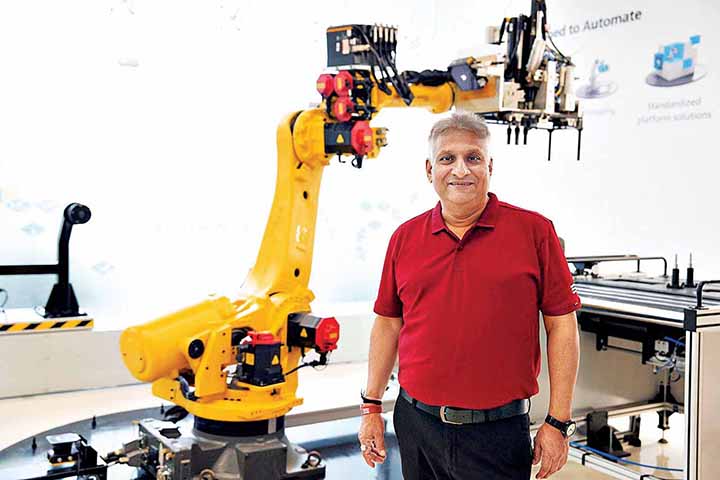
Q. What role does the Innovation Centre play in Atlas Copco’s manufacturing strategy?
A. The Innovation Centre acts as a platform where customers can experience advanced technologies in a realistic manufacturing environment. While these technologies may be available globally, their true value is realised only when customers understand how to implement them in their specific operations. The goal is to demonstrate capabilities rather than merely showcase products. Through live demonstrations, manufacturers can assess applications, comprehend process integration, and visualise how to implement these technologies before making investment decisions. The positive feedback received during the first edition of Innovation Days highlighted the significance of such initiatives and motivated Atlas Copco to further expand the concept.
Q. How has the facility evolved since its establishment?
A. The Industrial Technique business moved into the Pune facility in 2011. Initially, parts of the ground floor were used for assembly activities. However, as customer engagement requirements evolved, the facility was transformed into an Innovation Centre in 2023. Today, it functions as a dedicated environment where technologies are displayed, tested and adapted according to customer requirements. The focus is on communicating the value of manufacturing technologies and demonstrating how they can address specific industrial challenges.
Q. Why are demonstration-led platforms becoming increasingly important for manufacturing customers?
A. Manufacturing investments are becoming more sophisticated and capital intensive. Customers often prefer to see technologies operating in realistic conditions before committing resources. Live demonstrations help bridge the gap between innovation and implementation by allowing users to assess feasibility, productivity improvements and process benefits firsthand. Customers often gain entirely new perspectives after experiencing technologies in operation, making such platforms an effective way to accelerate technology adoption.
Q. Artificial intelligence is becoming a major industry focus. How is Atlas Copco integrating AI into its manufacturing solutions?
A. Artificial intelligence ultimately depends on data. Atlas Copco has been investing in data collection and process monitoring capabilities for many years through its tightening systems, controllers and software platforms. Long before AI became a mainstream discussion, the company’s solutions were already generating manufacturing data that could be analysed to improve production performance.
Today, AI enables manufacturers to utilise that information more effectively. Platforms such as ALTURE support data-driven decision-making by helping customers analyse process performance, identify trends and improve operational efficiency. The company also benefits from global competence centres that continuously develop solutions for customers pursuing digital manufacturing strategies.
Q. Which manufacturing sectors are currently driving the highest demand for innovation?
A. The automotive sector remains one of the strongest drivers of manufacturing innovation. While internal combustion engine vehicles continue to present opportunities for productivity improvement and automation, the emergence of electric vehicles has accelerated demand for advanced manufacturing technologies. EV production places greater emphasis on consistency, traceability and quality assurance, particularly in battery assembly and safety-critical processes. As a result, manufacturers are increasingly investing in automation, joining technologies, dispensing solutions and quality monitoring systems.
Q. How is the EV transition changing factory requirements?
A. The transition towards electric mobility is creating new manufacturing challenges. Battery packs, battery cells and lightweight vehicle structures require highly controlled assembly processes. Reliability expectations are also significantly higher because customers expect assurance regarding product quality and safety.
This is creating demand for advanced technologies such as dispensing systems, automated assembly solutions, vision-based quality inspection and connected production platforms. Manufacturers are seeking ways to improve process consistency while maintaining high productivity levels. Automation is becoming increasingly important because EV technology is still evolving, and manufacturers must ensure confidence in their products from day one.
Q. Indian OEMs are investing aggressively in manufacturing. How do you assess the current investment environment?
A. The investment outlook remains positive. As a multinational organisation, Atlas Copco interacts with customers and colleagues across global markets, providing a broad perspective on manufacturing trends. Compared to many regions, India currently demonstrates a strong commitment towards industrial expansion and manufacturing investments. Vehicle manufacturers continue to increase capacity, modernise production facilities and introduce new technologies. The willingness of multiple OEMs to invest simultaneously reflects confidence in the long-term growth potential of the Indian market. The level of investment activity across the automotive sector remains encouraging and indicates a positive direction for Indian manufacturing.
Q. How does Atlas Copco adapt global technologies for Indian customers?
A. While products are manufactured across Atlas Copco’s global network, customer solutions are developed locally. Manufacturing applications often require significant levels of customisation depending on production requirements, process complexity and customer objectives. The Indian engineering team works closely with customers to understand specific applications before integrating appropriate technologies. These may include vision systems, automation modules, software platforms, screw feeding systems, robotic dispensing solutions or tightening technologies. The objective is to create application-specific solutions rather than offer standardised products.
Q. What are the biggest challenges facing manufacturing transformation today?
A. Technology itself is rarely the biggest obstacle. One of the most significant challenges is the acceptance of change. Every major industrial transition requires organisations to adapt their processes, skill sets and operating practices. Employees may initially view automation as disruptive, while companies often require time to develop confidence in new technologies. Competence development, therefore, becomes critical. Manufacturers must invest not only in equipment but also in training, knowledge development and organisational readiness. Successful transformation depends on balancing technological innovation with effective change management.
Q. How do you see the future of manufacturing in India?
A. The outlook remains highly optimistic. India continues to attract manufacturing investments across automotive and industrial sectors, supported by strong domestic demand and ongoing industrial development. While challenges such as supply chain disruptions, geopolitical uncertainties and cost pressures remain part of the business environment, the overall growth trajectory remains positive. Future factories are expected to become increasingly connected, intelligent and data-driven. Technologies such as automation, machine vision, advanced joining systems, digital traceability and AI-enabled analytics will play a greater role in improving productivity and quality. The pace of adoption may vary across industries, but the direction of travel is clear: manufacturing is moving towards more integrated and intelligent production ecosystems.