

In conversation with Arvind Chandra, CEO, Tenneco India, with Niharika Singh, on navigating challenges and unlocking the next phase of growth.
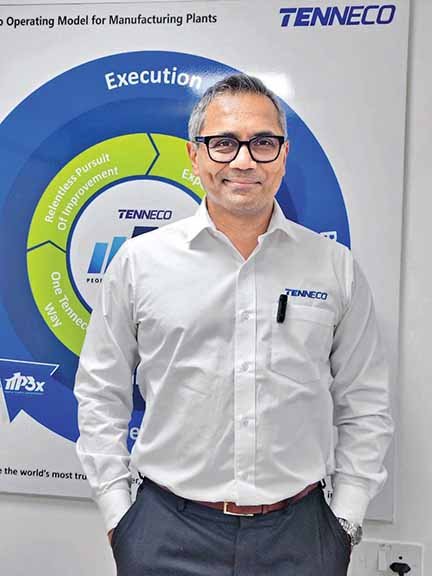
Arvind Chandra, CEO, Tenneco India
Q. What were the key growth drivers and headwinds for Tenneco during Q1 and YTD 2026 basis?
A. Tenneco performed strongly despite several external headwinds, including geopolitical tensions in the Middle East and increases in commodity prices. The company is exposed to commodities such as crude oil, LPG, CNG, plastics, rubber and steel, all of which have an impact on manufacturing costs. Despite these pressures, the company was able to recover a portion of the increased costs through customer recoveries and internal productivity improvements. Revenue grew 18%, outperforming the market, which grew approximately 16% on a volume basis. Commodity pressures impacted EBITDA margins by around 40-50 basis points. However, strong purchasing efforts and operational efficiency improvements at the plants helped offset a significant portion of the impact. Overall, the company achieved approximately 60 basis points of recovery, supporting an EBITDA margin of 17.9%. Growth was also supported by strong business wins across the company’s product portfolio. In Advanced Ride Technologies, DaVinci has gained significant traction, with four new customers and three new applications booked with an existing customer. In Clean Air and Powertrain, Tenneco secured a spark plug business with a leading Indian passenger vehicle OEM, while also growing its hot-end and cold end systems across multiple customers. Exports also performed well, including an all-terrain vehicle business award and heat exchanger business with Tenneco US. Overall, the company recorded strong bookings and growth across Clean Air, Powertrain and Advanced Ride Technologies, while maintaining margins despite the challenging environment.
Q. What are the key focus trends for the company?
A. Our focus is on growth through increased content per vehicle, exports and market-share expansion. On the suspension side, Tenneco’s market share has increased from approximately 48% before the IPO to more than 55%. This represents a significant increase in a relatively short period, driven in part by Da Vinci and new suspension technologies. In Clean Air and Powertrain, particularly in commercial trucks, market share has increased from approximately 57% to 58%. At the same time, our plants continue to focus on the P3 operating model, which is aimed at reducing costs, improving operational efficiency and quality, and strengthening the overall cost structure. Leadership development and succession planning are also important priorities as we focus on building the next generation of talent within the organisation.
Q. How is Tenneco’s business exposure distributed across passengers vehicles, commercial vehicles,LCVs, trucks and off- highway equipment, as well as OE and aftermarket?
A. Tenneco has a broad customer base in India and supplies to more than 100 customers. We have exposure across passenger vehicles, commercial vehicles and other segments, with a presence across the major vehicle manufacturers. Electric vehicle exposure is currently concentrated in the suspension business because electric vehicles do not require exhaust systems. However, EVs still represent a relatively small portion of the overall vehicle population, so this is not currently a major concern for the company. Tenneco remains primarily focused on the OE business. Shock absorbers and spark plugs are available through the aftermarket, but the company has deliberately focused on its OE business. The objective is to develop OE products that are designed to last throughout the vehicle’s lifecycle. This approach is particularly relevant for suspension and exhaust systems, where long-term durability is important.
Q. With evolving CAFE norms, electrification and changing customer preferences,how is Tenneco positioning itself to remain relevant?
A. Tenneco is focused on being technology-ready across different powertrain and regulatory scenarios. CAFE 3, for example, will drive the adoption of technologies aimed at reducing CO2 emissions. The transition from multi-port injection to gasoline direct injection can increase the requirement for gasoline particulate filters, which is an area where Tenneco has already secured business with a major Indian passenger vehicle OEM. The company expects this technology to become relevant as CAFE 3 implementation progresses, with the business expected to come into play around FY2028 and beyond. Tenneco is also preparing for increased hybridisation. Hybrid vehicles can require compact exhaust gas management solutions, and the company has developed technologies such as flat pipes and acoustic valves for mufflers. The objective is to remain technology-ready irrespective of the direction in which the market evolves.
Q. Could you elaborate on Tenneco’s Clean Air, Powertrain and performance solutions portfolio and its approach to the aftermarket?
A. Tenneco’s Clean Air products, including particulate filters, SCR systems, catalytic converters and mixers, are designed primarily as OE-fitment systems with durability over the life of the vehicle. These are large and complex systems, and replacing an entire exhaust system through the aftermarket is very different from replacing a component such as a spark plug. Spark plugs have a more defined replacement cycle, although even here OEMs are increasingly seeking products with longer durability. The company’s approach is therefore focused on developing durable OE products, while remaining open to aftermarket opportunities where new technologies create an attractive opportunity.
Q. As the industry moves towards software-defined vehicles, connected technologies and sustainability, how is Tenneco investing in R&D and innovation?
A. Software-defined vehicles are being driven partly by the need to reduce vehicle cost and weight. Modern vehicles have a large number of electronic control units and extensive wiring, adding significant weight and cost. The industry is therefore moving towards integrated systems and zonal architectures. Tenneco’s semi-active suspension technologies, which incorporate electronics and software, are positioned to support this transition. Software and connectivity also enable greater control over vehicle functions through sensors, actuators and over-the-air updates. In suspension applications, this can enable OEMs to adjust parameters such as damping and hydraulic control through electronic systems. This transition towards software-defined vehicles is gaining momentum in India, and Tenneco is developing its technologies to support these changing vehicle architectures.
Q. How is Tenneco aligning its engine components with India’s emission requirements and the transition towards higher ethanol blends?
A. Tenneco is preparing its technologies for higher ethanol blends. The company is already technology-ready for E85 applications, including spark plug technologies and corrosion-resistant exhaust systems. Higher ethanol blends require technologies that can address issues such as moisture absorption, corrosion and fuel-injection requirements. Tenneco has developed technologies to address these requirements. The transition towards higher ethanol blends can contribute to lower CO2 emissions, although it also involves considerations such as lower energy density and the need for appropriate materials and technologies.
Q. Supply- chain resilience and cost pressures remain major concerns for automotive suppliers. What measures has Tenneco taken to strengthen its manufacturing footprint and improve operational efficiency in India?
A. Tenneco manages commodity exposure through a combination of customer indexation, purchasing strategies and manufacturing productivity. For indexed commodities such as steel, the company has back-to-back indexation arrangements with OEM customers, allowing price movements to be recovered with a defined time lag. Non-indexed commodities such as oil, CNG, LPG, rubber and plastics present a greater challenge. The purchasing team works on spot buying and cost optimisation, while the sales and commercial teams work to recover appropriate cost increases from customers. At the manufacturing level, Tenneco continues to focus on operational transformation through the P3 operating model. This includes improving quality, operational effectiveness, availability, productivity and overall factory-level cost efficiency. These initiatives helped mitigate the impact of commodity inflation and supported the company’s 17.9% EBITDA margin.
Q. What are the key near- to mid-term milestones Tenneco is preparing for, and how are investments being aligned to achieve them?
A. The priorities are centred on growth, order-book expansion, exports and market-share gains. The first lever is increasing content per vehicle through technologies such as DaVinci, semi-active suspension solutions, hot-end and cold-end systems, spark plugs and products aligned with future CAFE and BS7 requirements. The second is exports. Tenneco intends to expand exports across its product portfolio, serving both Tenneco entities and third-party OEMs. The third is market-share expansion. The increase in suspension market share from 48% to more than 55%, along with the increase in commercial clean air and powertrain market share from 57% to 58%, demonstrates the potential for further white-space opportunities. Alongside growth, factory-level transformation through the P3 operating model remains a core focus. The company’s approach can be viewed through three priorities: growth, cost competitiveness and people development. Developing the next generation of leaders and strengthening succession planning will remain an important part of Tenneco’s long-term strategy.