


In conversation with Nisarg Pandya, Founder and CEO of drivebuddyAI. By Niharika Singh,about AI-powered ADAS, driver monitoring, patented lane detection, and the future of automotive safety.
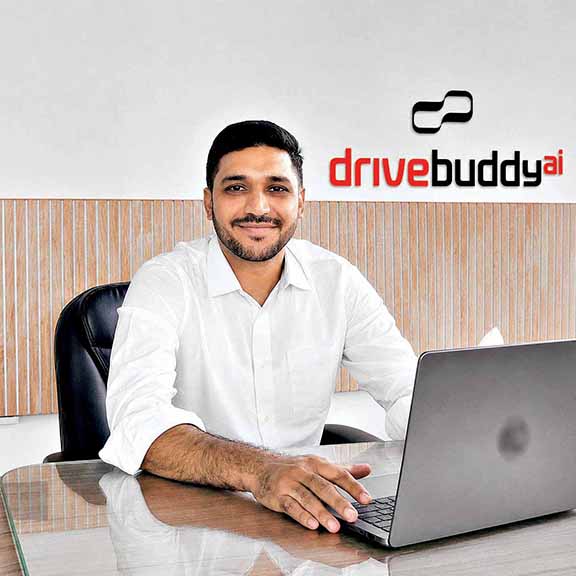
Nisarg Pandya, Founder and CEO of drivebuddyAI
Q. DrivebuddyAI showcased its pre-compliant in-cabin safety technology at InCabin USA 2026. How are discussions with global OEMs and Tier-1 suppliers shaping the future development and integration of your in-cabin safety solutions?
A. The discussions with global OEMs and Tier-1 suppliers at InCabin USA 2026 reinforced a clear industry shift that Driver Monitoring Systems are no longer being viewed as standalone compliance features, but as a foundational layer for the future of intelligent, human-centric mobility. While regulatory compliance remains a key driver, manufacturers are increasingly focused on how these systems perform in real-world conditions and how seamlessly they can be integrated into diverse vehicle platforms across global markets.
These conversations are helping shape our development priorities in three important areas. First, there is growing demand for flexible, software-led architectures that can support multiple safety functions including driver monitoring, distraction detection, occupant monitoring, and engagement monitoring through a unified platform. Second, OEMs are looking for solutions that can accelerate compliance with evolving regulations without adding unnecessary hardware complexity. Third, there is increasing recognition that AI systems trained on large-scale, real-world driving data deliver stronger performance than solutions developed primarily through controlled or scenario-based environments.
drivebuddyAI’s experience in deploying and continuously refining AI across billions of kilometres of driving data has enabled us to build an in-cabin perception system that understands driver behaviour with greater contextual awareness and robustness. The feedback and engagement at InCabin USA have validated this approach and are helping us further strengthen our roadmap.
Going forward, our focus will remain on advancements, expanding integration readiness for global OEM and Tier-1 programs, and developing safety technologies that move beyond compliance to actively improve driver and occupant safety.
Q. With in-cabin sensing regulations evolving across global markets, what technical capabilities are OEMs prioritizing, and how is DrivebuddyAI preparing its solutions to meet these future requirements?
A. As in-cabin safety regulations continue to evolve, OEMs are increasingly prioritizing solutions that combine regulatory compliance with real-world performance. Key areas of focus include advanced driver monitoring, distraction and drowsiness detection, occupant monitoring, driver engagement tracking, and the ability to support multiple safety functions through a unified, software-driven architecture.
At drivebuddyAI, we are preparing for these requirements by continuously enhancing our AI models using billions of kilometres of real-world driving data and designing our platform to align with evolving standards. Our focus is on building robust, in-cabin intelligence that can be seamlessly integrated across vehicle platforms while remaining scalable for future safety and automation requirements.
Q. Your recently granted Indian patent for AI-powered Lane ROI Detection is a significant milestone. What technical advancements does this innovation bring to lane detection, particularly in challenging and diverse driving conditions?
A. drivebuddyAI’s Lane ROI Detection technology addresses one of the most fundamental challenges in ADAS – accurately identifying the vehicle’s drivable corridor in dynamic real-world conditions. Traditional lane detection systems often rely on static calibration and can struggle when faced with inconsistent lane markings, changing road geometries, adverse weather, low-light environments, or variations in camera installation and vehicle platforms.
The key innovation lies in our self-calibrating, AI-driven framework that continuously validates and optimises lane detection in real time. The system automatically selects high-confidence video frames for lane computation, adapts to different vehicle configurations, and recalibrates itself during installation, software updates, or system reboots without manual intervention.
Because the technology has been trained and validated on over 6.4 billion kilometres of real-world driving data, it is designed to perform reliably across highways, urban roads, rural routes, and complex mixed-traffic environments. This results in more accurate lane perception, fewer false alerts, and stronger performance for critical ADAS functions such as lane departure warning, forward collision warning, and future autonomous driving applications.
Q. How do you see this patented lane detection technology contributing to the next generation of ADAS, and what role will it play in enhancing the safety and intelligence of future vehicles?
A. Lane perception is one of the foundational building blocks of modern ADAS and future autonomous driving systems. The ability to accurately understand a vehicle’s drivable corridor directly influences the effectiveness of critical safety functions such as lane departure warning, forward collision warning, adaptive cruise control, autonomous emergency braking, and steering assistance.
Our patented Lane ROI Detection technology strengthens this foundation by enabling continuous, self-calibrating lane perception that can adapt to changing road conditions, vehicle platforms, and operating environments. As vehicles become increasingly software-defined and intelligent, the need for systems that can continuously learn, optimize, and maintain accuracy without manual intervention will become even more important.
We believe this technology will play a key role in enabling the next generation of ADAS by improving reliability, reducing false alerts, and providing more robust environmental understanding for advanced safety and automation features. Ultimately, our goal is to help create vehicles that are not only more compliant and connected but also safer, smarter, and better equipped to navigate real-world driving complexities.
Q. Global players like Mobileye, Seeing Machines, and Lytx are actively expanding into emerging markets. What is your core defensible advantage against these well-capitalised competitors in the Indian and South Asian context?
A. Our core advantage lies in the depth of our India-specific driving intelligence and operational experience. We have spent the last six years building and refining our platform using more than 4 billion kilometres of driving data collected across Indian roads. This has enabled us to train our AI on the unique road conditions, driver behaviours, infrastructure challenges, and edge cases that are difficult for new entrants to replicate quickly. While global players bring scale and brand recognition, success in markets like India depends on contextual intelligence developed through years of real-world deployment.
Equally important is the trust we have built with fleet operators. Our long-term partnerships across hazardous materials, LPG distribution, and logistics sectors are a result of proven performance and deep integration into customers’ safety workflows. In addition, our platform is certified under AIS-184 by ARAI as well as EU 2144/2019 and Euro NCAP 2026 standards by IDIADA, demonstrating that a solution built for Indian roads can meet global safety benchmarks. Together, our extensive driving dataset, local market expertise, strong customer relationships, and global validation create a competitive advantage that is difficult to replicate in the Indian and South Asian markets.
Q. The Indian commercial fleet market is highly price-sensitive. How are you positioning the ROI of an AI-powered DMS solution to fleet operators who may still rely on traditional, compliance-based safety approaches?
A. The Indian commercial fleet market is often described as price-sensitive, but we see it as increasingly value-sensitive. Fleet operators today are looking beyond the cost of a device and focusing on the safety and operational benefits it delivers. When the cost of a preventable accident can run into millions of rupees through cargo loss, vehicle damage, liability, and downtime, the emphasis naturally shifts to reliability and performance. Our customers want to understand how accurately the system detects risks such as drowsiness, how it minimizes false alerts, and how consistently it performs in real-world driving conditions.
This focus on outcomes is driving adoption of our premium safety services, including Command Centre as a Service and proactive monitoring solutions. Rather than relying solely on post-event reporting, fleet operators are increasingly seeking technologies that help identify risks early and enable timely intervention. The long-term partnerships we have built across logistics and industrial transport sectors reflect the value of this approach. Ultimately, customers are investing not just in a technology platform, but in a trusted safety partner that helps improve driver safety, reduce operational risk, and support business continuity.

