


As electrification, Bharat NCAP and fuel-efficiency norms reshape vehicle engineering priorities, Body-in-White is emerging as one of the most strategic battlegrounds in India’s passenger vehicle industry, writes Ashish Bhatia.
Operation Sindoor may ultimately be remembered not merely as a military operation, but as a defining stress test for India’s rapidly evolving defence ecosystem. The operation brought India’s multi-layered air-defence preparedness into sharp focus, particularly the operational deployment of the Russian-origin S-400 Triumf systems, which emerged as a critical defensive shield amid heightened regional tensions. But beyond the battlefield optics, Operation Sindoor also underlined India’s shift from reactive procurement to long-term strategic deterrence.
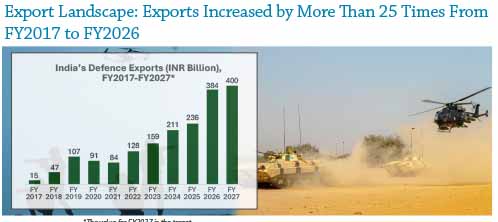
In many ways, defence is no longer just about protection. It is becoming India’s next industrial growth engine. A new report by Rubix Data Sciences captures the scale of that transformation. India’s defence production reached a record INR 1.54 trillion in FY2025, nearly 3.2 times higher than FY2015 levels, while defence exports have surged 25-fold since FY2017 to touch an all-time high of INR 384 billion in FY2026. The momentum is now extending far beyond conventional military modernisation. India’s defence budget has nearly tripled from INR 2.53 trillion in FY2014 to INR 7.85 trillion in FY2027, accounting for 14.67 per cent of the Union Budget, the highest allocation among all ministries.
The S-400 air-defence system has become symbolic of India’s evolving strategic posture. As of April 2026, Russia had already shipped the fourth of the five ordered S-400 Triumf systems, with the fifth expected later this year. The system played what the Rubix report described as a “critical defensive role” during Operation Sindoor. But the S-400 story also reflects a broader procurement transition underway. India is no longer pursuing defence imports as isolated acquisitions. Instead, procurements are increasingly linked to technology transfer, domestic manufacturing, local supply-chain integration, lifecycle support, and future export capabilities. The Defence Acquisition Council cleared procurement proposals worth a record USD 71 billion during FY2026, the highest ever in a single financial year. These included additional S-400 systems, Rafale fighter jet discussions, transport aircraft, remotely piloted strike platforms, surveillance systems, gun systems, and maritime platforms.
Importantly, India’s procurement diversification is accelerating. Russia’s share in India’s arms imports has dropped sharply from 70 per cent during 2011–2015 to around 40 per cent during 2021–2025, while France has emerged as the second-largest supplier with a 29 per cent share, followed by Israel at roughly 15 per cent. That diversification is strategic rather than political. India is simultaneously reducing overdependence on a single supplier, leveraging multiple technology ecosystems, and extracting greater localisation commitments.
In FY2025, the Ministry of Defence signed 193 contracts worth INR 2.09 trillion, with 92 per cent of contract volume and 81 per cent of value directed towards Indian firms. That shift marks a dramatic reversal from the previous decade, when India depended on imports for nearly 65–70 per cent of defence requirements. Today, approximately 65 per cent of defence equipment is produced domestically. This localisation push is increasingly visible across missiles, artillery, naval platforms, drones, surveillance systems, electronics, and aerospace manufacturing.
The Advanced Towed Artillery Gun System (ATAGS), jointly developed by DRDO and private industry, has emerged as a showcase example of this transition. Developed with over 65 per cent domestic sourcing, the indigenous artillery platform has already been exported to Armenia. Similarly, India’s Pinaka rocket systems, Akash air-defence systems, Swathi radars and BrahMos missiles are steadily moving into global export conversations.
The Export Engine
Perhaps the most striking transformation is occurring on the export front. India’s defence exports touched INR 384 billion in FY2026, rising 63 per cent year-on-year and 25 times over FY2017 levels. The government is now targeting INR 500 billion in exports by FY2029. India is no longer exporting only low-value defence components or protective equipment. According to the Rubix report, ships accounted for nearly 55 per cent of India’s defence exports between 2016 and 2025, followed by artillery systems at 13 per cent and missiles at 12 per cent. The BrahMos missile programme remains one of the most strategically important export stories. Following deals with the Philippines, India moved closer to finalising BrahMos export agreements with Vietnam and Indonesia, valued at over INR 40 billion collectively.
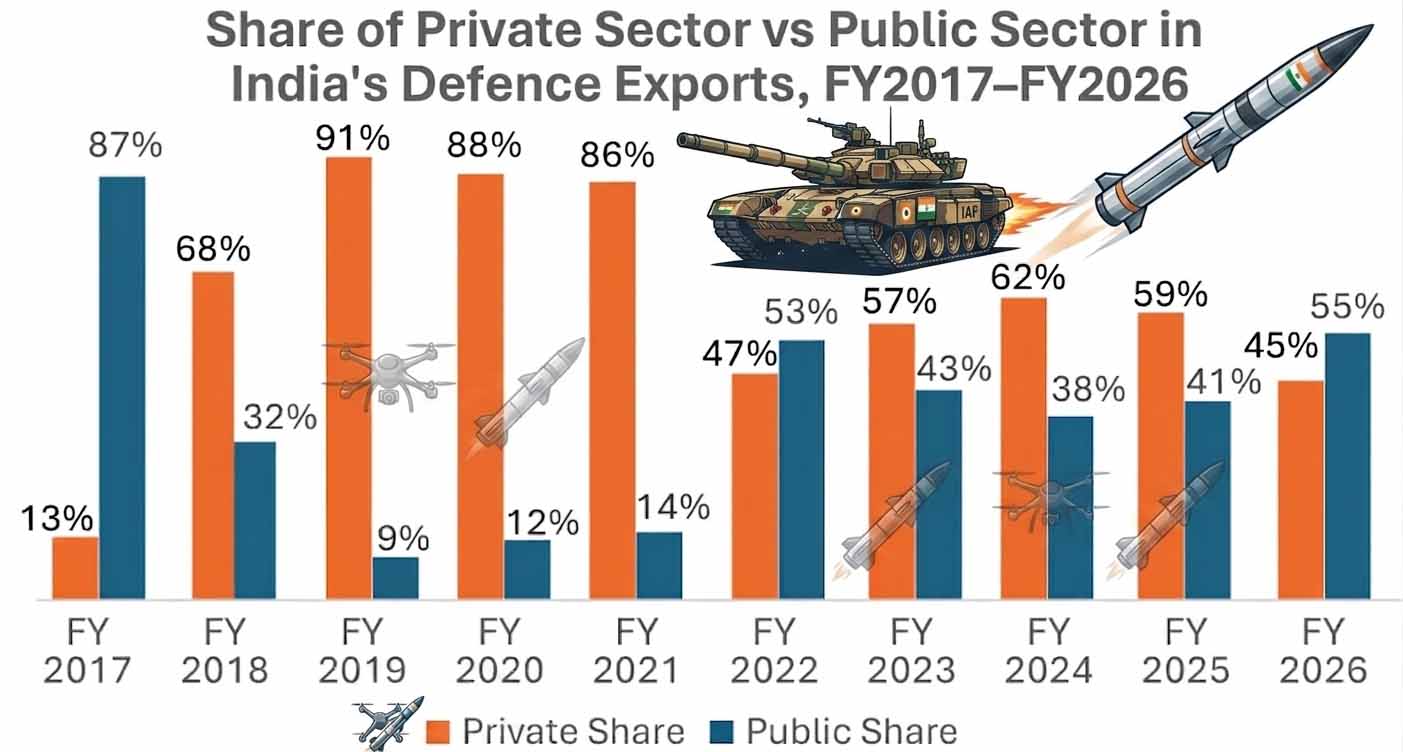
Another major shift is the accelerating role of private industry. The private sector’s share in defence production has increased from 19 per cent in FY2017 to 23 per cent in FY2025. Meanwhile, private firms accounted for nearly 45 per cent of defence exports during FY2026. Companies such as Tata Advanced Systems, Bharat Forge, Larsen & Toubro, Adani Defence, Reliance Defence, Paras Defence, and Kalyani Strategic Systems are increasingly moving beyond component supply into full-system participation.
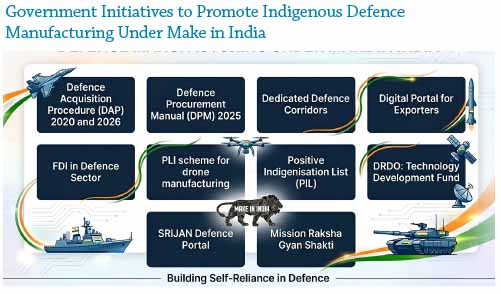
The scale of ongoing projects highlights that evolution. Tata Advanced Systems recently secured contracts linked to the overhaul and upgrade of in-service Pinaka Multiple Launch Rocket Systems. Bharat Forge secured indigenous CQB carbine contracts worth INR 16.6 billion alongside additional unmanned systems orders. L&T continues expanding indigenous defence manufacturing around the K9 Vajra-T programme and BvS10 Sindhu platforms. Adani Defence signed an MoU with Leonardo to establish an integrated helicopter manufacturing ecosystem in India covering manufacturing, MRO and training support. The common thread across these projects is localisation depth. The era of simple screwdriver assembly operations is gradually fading. India’s next-generation defence procurement ecosystem increasingly demands local manufacturing, domestic value addition, engineering participation, lifecycle support, and ecosystem development. The draft Defence Acquisition Procedure (DAP) 2026 proposes increasing indigenous content requirements from 50 per cent to 60 per cent under the Buy Indian-IDDM category. That change could significantly reshape procurement economics across aerospace, naval systems, electronics and defence mobility platforms. The shift is already visible through Defence Industrial Corridors, Positive Indigenisation Lists, iDEX initiatives, SRIJAN portal integration, and the Technology Development Fund. The Uttar Pradesh and Tamil Nadu Defence Corridors together have already attracted investments exceeding INR 91.4 billion, with 289 MoUs signed. The Shirdi factor also becomes relevant here. As India expands aerospace and defence manufacturing ecosystems beyond traditional industrial belts, emerging centres such as Shirdi are increasingly seeing interest around aerospace component ecosystems, MRO-linked opportunities and precision manufacturing clusters aligned with defence supply-chain diversification.
FTAs
India’s evolving Free Trade Agreement architecture may become one of the most underappreciated enablers of defence manufacturing. FTAs with regions including Europe, the UK, the UAE, and Australia could significantly influence aerospace supply chains, precision manufacturing, electronics sourcing, advanced materials, semiconductors, and defence component exports. This becomes especially relevant as global OEMs increasingly look to diversify manufacturing away from concentrated supply-chain geographies. India’s defence ecosystem is increasingly positioning itself as a trusted manufacturing alternative, an engineering base, and a long-term strategic production partner. The customs-duty waiver on aircraft manufacturing inputs and the push towards domestic MRO capabilities are already supporting this transition.
Drone,AI and Autonomous Warfare
India’s defence transformation is not limited to traditional platforms. Modern warfare is increasingly shifting towards drones, AI-led systems, autonomous platforms, electronic warfare, and surveillance ecosystems. India now has more than 1,000 defence start-ups operating across the ecosystem. Collectively, aerospace, maritime and defence-tech start-ups have attracted nearly USD 2 billion in funding since 2017. The government’s INR 20 billion drone incentive programme aims to localise at least 40 per cent of critical drone components by FY2028. This next-generation warfare ecosystem could ultimately become one of India’s biggest defence export opportunities. Operation Sindoor merely accelerated visibility around that reality.

