

Aakash Minda, Executive Director, Spark Minda, discusses supply-chain resilience, localisation, technology, skills and growth towards 2030, in conversation with Richa Tyagi.
What does ‘Beyond Resilience’ mean for India’s auto component industry in the current scenario?
When we speak about going beyond resilience, the idea is that the entire auto component and automotive industry must build a deep, resilient supply chain. This involves supporting Tier-2 and Tier-3 suppliers, upgrading the complete ecosystem, and significantly reducing dependency on overseas imports. Our focus must be on increasing capacity, investing in vertical integration, and building an ecosystem that limits external dependencies. Building a resilient supply chain is the core focus for the entire industry.
“Our strategy is not just to ride the growth curve but to compound our investments into the next generation of products.”
Spark Minda has a strong presence across several automotive component segments. Which product and technology areas do you see driving the company’s next phase of growth?
Our focus and investments are centred on the premiumisation of our products. At the same time, we are looking at adding new products through our technical centre, which we recently launched. We are also working on new product launches and partnerships that will expand our capabilities. Exports are another important avenue for growth, while passenger vehicles are an area where we are seeing several new products and launches. Market demand will certainly play a role over the coming quarters and years, but our objective is not simply to ride that demand cycle. We want to continuously expand our product portfolio and add premiumised products across the value chain and segments. Our larger ambition is to become a system solution provider for the automotive industry, rather than limiting ourselves to individual components.
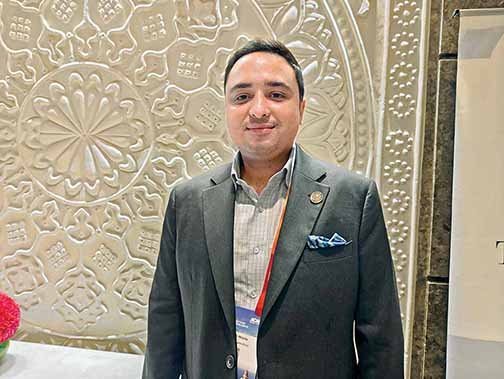
Akash Minda, Executive Director, Spark Minda
India is increasingly emerging as a global sourcing destination. What more needs to be done to make Indian component manufacturers globally competitive in technology, quality and cost?
One of the most important areas of focus has to be backward integration and localisation, along with stronger systems and processes. To truly compete with global companies entering India and to deliver the right quality of products, we must invest in our own competencies and capabilities. This spans operations, talent management, and digitisation. Crucially, we must upgrade the Tier-2 and Tier-3 suppliers that many of us rely on. Combining all these factors will upgrade the complete ecosystem, making us highly competitive for the export market.
How significant is the skill gap for Spark Minda and the wider automotive industry, particularly as technology requirements continue to change?
A lot of work is already being done across large Tier-1 companies, with OEMs also playing an important role in supporting capability development. At Spark Minda, we are working with government bodies and have our own skill development initiatives. We are also working with local government bodies and developing capabilities within our plants. The objective is to improve skills right from the grassroots level, including associates on the shop floor, all the way up to senior leadership. The requirement is not only about technical skills. The industry is undergoing significant changes in terms of how businesses operate, the technologies being adopted and the expectations of customers. Therefore, employees need to understand these changes and adapt to new ways of working. Building the right mindset, improving capabilities and developing an understanding of emerging requirements will be critical to strengthening the industry’s competitiveness.
“Our focus must be on increasing capacity, investing in vertical integration, and building an ecosystem that limits external dependencies.
Looking towards 2030, what do you see as the biggest growth opportunities for Spark Minda, and what will define the company’s competitiveness?
The biggest growth engines for Spark Minda will be organic growth, inorganic growth, and technology. We are continuously investing in upgrading our product lines and system solution offerings by investing in our own R&D technology centre and seeking out strategic partnerships. Our strategy is not just to ride the growth curve but to compound our investments into the next generation of products. This includes launching new products across passenger vehicles, commercial vehicles, and two-wheelers, often as complete system solutions. We will also continue investing in operational excellence by opening new plants, building talent from within, advancing R&D, and localising Tier-2 and Tier-3 supply chains. By focusing on delivering high value-add components and systems to our customers, we will secure our competitiveness and drive continuous growth toward 2030.