

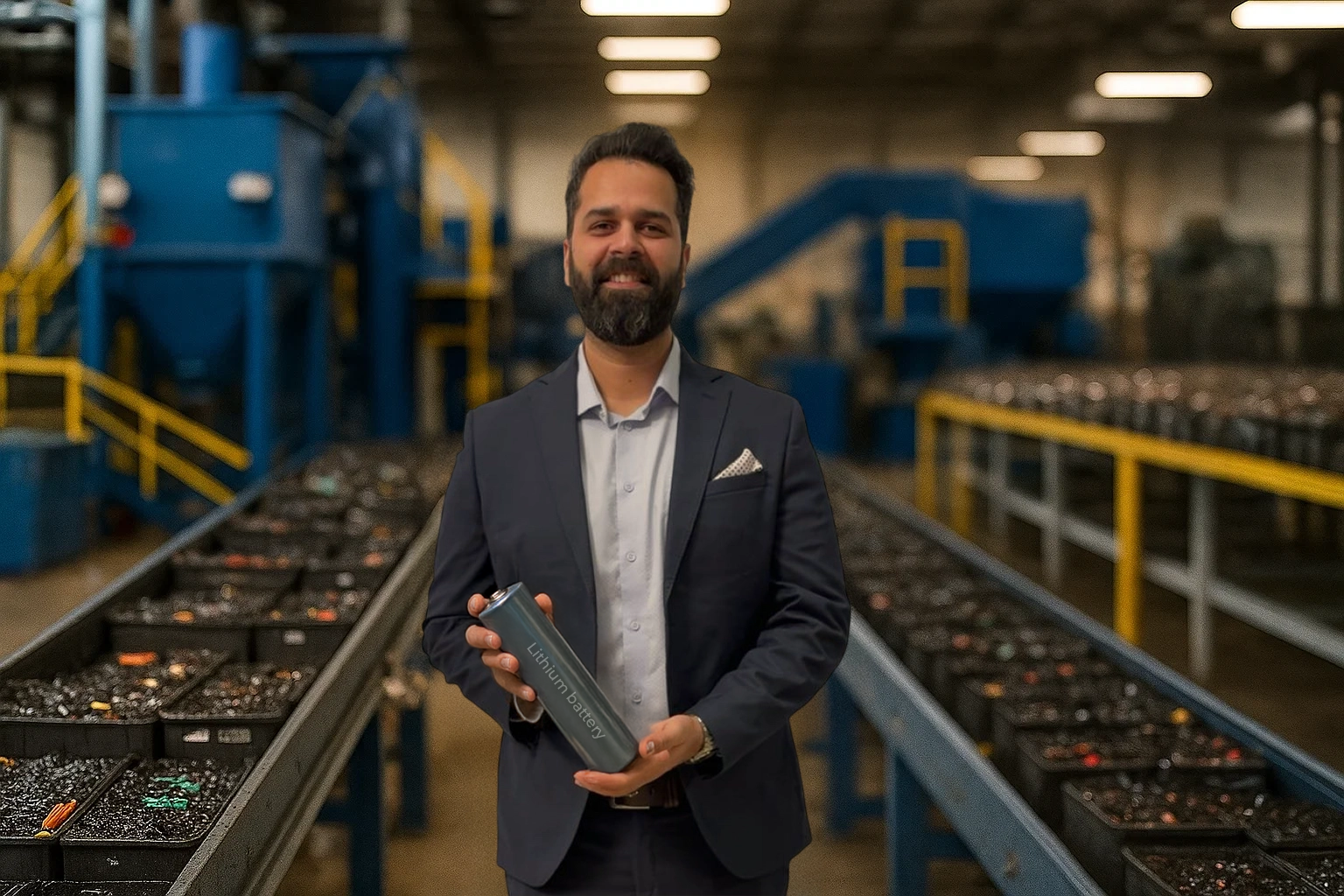
India’s electric mobility sector is rapidly evolving, and one company at the forefront is Mobec Innovation, India’s first portable EV charging provider. But Mobec’s vision goes far beyond charging cars. The company is building a complete ecosystem that includes energy storage, battery recycling, and second-life applications for used batteries.
In this conversation with Richa Tyagi, Harry Bajaj, the mind behind Mobec Innovation, shares his journey and explains how his vision is reshaping the EV landscape.
You studied in Ukraine and later pursued postgraduate studies in Singapore. How did those experiences shape your mindset?
To be honest, the education itself wasn’t the biggest factor. What truly influenced me was the environment, culture, and the people I interacted with. Being exposed to different ways of thinking broadened my perspective and provided invaluable experiences that have shaped what we’re building today at Mobec.
Your background includes work in marketing. How did the idea of portable EV charging come about?
Since childhood, I have always been deeply fascinated by technology and loved building new things. Regardless of my past job roles or formal education, that passion never stopped me from experimenting with technology and mechanics, often tinkering and creating on my own. The idea of a mobile charging solution came when I wanted to buy an EV myself. But I faced the age-old dilemma: how would I charge it? Before committing to purchasing an EV, I decided to first find a solution to this problem. That’s when the idea was born. We began researching, brought talented minds into the team, and initially tried to build a solution just for myself. But when the prototype turned out to be both successful and practical, we realised its broader potential, and that’s when we decided to build a company around it.
Who are your customers, and how do you approach the market?
We are primarily a B2B, product-first company. Our core strength lies in portability and energy storage solutions, and based on that, we offer 100 per cent customised products. Whether it’s design, delivery, or capacity, we adapt to the specific requirements of each business. That’s why our main focus is firmly on the B2B sector. We have already collaborated with a few OEMs, deploying some of our innovative product designs as part of go-to-market research. In addition, we have partnered with several manufacturers who play a key role in supporting the broader EV ecosystem. Another area we are actively exploring is roadside assistance. Since our products are mobile, they can be implemented in a wide range of scenarios, making them especially effective for on-the-go support.
How does portable or mobile EV charging actually work, in layman’s terms?
It’s essentially like a power bank for electric vehicles. Just as you use a power bank to charge your mobile phone, our portable charger works on the same principle, but at a much larger scale. With our products, you can charge an EV or even other devices that require stored energy.
Do you have an app, or do regular customers need to contact a dealer? How do people reach you?
We do have business-specific applications, but since we operate primarily in the B2B space, our products are provided directly to businesses. What we also offer is our tech stack, which allows these businesses to integrate our solutions so that their end customers can easily reach them.
Mobec focuses on mobile EV charging, battery recycling, and energy storage. Why did you choose this integrated approach instead of just being a charging company?
That’s because we are not just a charging company, we are an innovation company. Our ultimate focus is the environment and aligning ourselves with the global efforts toward sustainability. Mobec is not limited to being a product company; we are also building solutions for battery recycling and are further expanding into renewable energy. Our approach is simple: to remain firmly within the green ecosystem, constantly innovate, and create solutions that contribute to a cleaner, more sustainable future.
How important is the circular economy concept for your business?
For us, it’s absolutely central; in fact, it’s the core of what we do. We are working to build a circular economy within our own company, which makes it extremely important. It’s not just about products or recycling; we want to address every aspect of the cycle. For us, it’s a truly circular approach in every sense.
And how did you approach the secondary aspects, like recycling? For example, to recycle, you need materials. How do you source used batteries?
We have built an extensive network across India to address this. We procure scrap batteries from across the country, from Tier 1 as well as Tier 2 cities, and process them at our own facility. It’s been almost a year since we started focusing specifically on recycling, and I believe we have established a strong footprint in terms of procurement and securing the right materials.
India’s government is pushing for eight per cent growth amid global uncertainty, and policies like the Income Tax Act 2025 aim to simplify compliance for businesses. Do you see these developments as enablers for green-tech entrepreneurs like you?
In general, both the central and state governments have various schemes for startups, including those in the green sector like ours. These often come in the form of incentives or tax rebates. However, we have not opted for any of these so far. Of course, during annual filings, the government does provide useful support to startups, but honestly, that’s the last thing we focus on. Even if there were no government support, though we acknowledge that they do help many startups, we have been able to sustain and grow on our own.
Also, with India and the UK signing a free trade agreement recently, does this open doors for Mobec in global markets?
Yes, absolutely. On both the product side and the recycling front, we are actively exploring opportunities to expand internationally. For example, we are looking at the Middle Eastern market, which is already quite mature in terms of EV adoption and where Battery Energy Storage Systems (BESS) are gaining strong traction. Beyond products, our commitment to building a circular ecosystem makes recycling a critical focus area, not just for India but also for regions like Africa and Europe. These markets hold significant potential, and we see them as important parts of our expansion journey.
How much of your products are localised?
On the recycling side, our business is 100 per cent localised. When it comes to the product side, to be frank, India currently does not yet have the full capability to manufacture certain high-end EV components with the required efficiency. That said, about 95 per cent of our product is made in India, while only a few specialised components are sourced from more developed economies abroad.
What about supply chain dependencies? With India and China moving closer amid global geopolitical shifts and tensions with the US, how are you planning for resilience?
For us, this is not really a concern because our business does not depend on EV manufacturing or rare-earth magnets used in cars. Our products are designed to power not just EVs but also tools and other energy-driven applications. In simple terms, we create an advanced power bank that can work across multiple use cases. So, while supply chain resilience may pose challenges for some companies in the EV industry, it doesn’t significantly affect us. Our model is inherently more flexible and less dependent on those vulnerable supply chains.
What regions are you currently serving with your portable charging solutions? Is it limited to Delhi NCR, or are you available elsewhere?
Our products are being deployed across India, including rural areas as well as Tier 1 cities. The idea is to design various applications and product models that can be easily adapted to different environments. We believe the environment should not have to adjust to our product; instead, our product should adapt to the environment. This flexibility allows us to serve both urban and rural markets effectively.
If someone calls for backup charging, how long does it typically take for your service to reach them?
While we are not a B2C company, we are working on models for such scenarios. Our aim is to ensure a response time of around 15 minutes for rescue charging. After that, we focus on fulfilling whatever specific requirements the customer may have.





Leave a Reply