


In the ever-evolving world of automotive manufacturing, Body-in-White (BiW), the stage where a vehicle’s sheet metal components are welded together to form the vehicle’s skeletal structure, has become a hotbed of innovation, writes Ashish Bhatia.
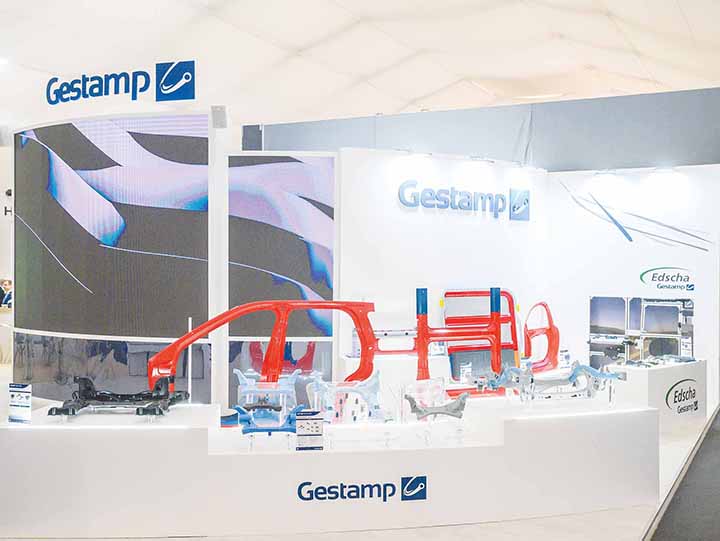
With increasing pressure from regulators and customers alike to produce safer, lighter, and more fuel-efficient vehicles, BiW suppliers have stepped up their game. From new age materials to advanced joining technologies and modular architectures, key suppliers across India and Europe are spearheading transformative changes. The latest BiW trends, spotlight major players like Gestamp and examine how Indian and European manufacturers are competing, collaborating, and preparing for the future of vehicle manufacturing.
Light weighting
One of the dominant themes in BiW evolution is light weighting. It directly influences fuel economy and tailpipe emissions in ICE vehicles, while also impacting the range and performance of EVs. Indian players like JBM Auto and Bharat Forge have increasingly focused on the development and integration of lightweight materials, such as Advanced High-Strength Steels (AHSS), boron steels, and aluminium alloys. These materials help reduce vehicle weight without compromising on structural integrity or crash safety.
European BiW specialist Gestamp, with its strong engineering base and global footprint, is pushing the envelope on light weighting. The company has deployed hot stamping extensively, a process that forms ultra-high-strength steel components under extreme temperatures. This technology allows for complex part geometries with improved safety performance, and is now being localised at scale in India to support domestic OEMs. Gestamp’s Pune and Chennai facilities are now manufacturing BiW components for Indian and global platforms, integrating high-tech joining techniques like laser welding, tailor-welded blanks, and riveting, while focusing on cost competitiveness for emerging markets.
Multiple Powertrains Demand Structural Reimagination
With multiple powertrains like Electric Vehicles (EVs) shifting the placement of key components like the powertrain and battery pack, BiW structures are being re imagined entirely. The traditional vehicle floor is now being replaced with “skateboard” designs, requiring completely new approaches to torsional rigidity and crash safety. Tier 1 suppliers in India, like Tata Autocomp and Krishna Maruti Group, are increasingly investing in R&D to develop BiW solutions optimised for EV platforms. They are working closely with OEMs to co-develop sub frames, battery trays, and crumple zones tailored to these new architectures.
In Europe, Gestamp, Magna, and Voestalpine are leading the push toward EV-centric BiW design. The recent trends include multi-material structures, combining steel, aluminium, and composite materials to achieve optimal strength-to-weight ratios. Their investment in flexible manufacturing lines allows production of BiW components for both ICE and EV platforms on shared tooling, improving agility and reducing costs.
Smart Manufacturing and Automation
Automation and digitalisation have redefined how BiW shops operate. In India, investments in smart welding robots, inline quality inspection systems, and predictive maintenance are growing, albeit gradually. Players like Mahindra CIE and Amtek Auto are beginning to implement Industry 4.0 principles for real-time data capture and control, improving uptime and part quality.
European counterparts are far ahead in digital integration. Gestamp’s Industry 4.0-enabled plants in Spain and Germany feature full digital twins of their production lines, enabling remote monitoring and AI-driven optimisation. In partnership with Siemens, Gestamp also uses AI to forecast tooling wear and dynamically adjust process parameters to reduce defects.
Modularisation and Platform Flexibility
BiW modules today are no longer just static structures but are designed with modular thinking in mind. In India, the growing use of common platforms among vehicle variants (MPVs, SUVs, sedans and CVs) is leading to demand for BiW subassemblies that can be easily reconfigured. This is being embraced by suppliers like Sona Comstar and SM Auto, which are supplying modular front-end and rear-end structures.
European OEMs like Volkswagen and Stellantis are pushing for even more aggressive modularity to enable quick shifts in model variants and body styles. Gestamp, working closely with these OEMs, has been tasked with designing front and rear underbody modules that are interchangeable across multiple vehicle types, reducing engineering time and tooling costs dramatically.
Safety Compliance And Global Benchmarks
As India adopts increasingly stringent crash norms under the Bharat NCAP regime, BiW design is under the spotlight. The need for crash worthy passenger compartments, side-impact beams, and integrated roll cages has made safety-driven innovation a top priority. Indian suppliers are collaborating with European technology partners to leapfrog design maturity, especially in crash simulations and validation.
Suppliers like Gestamp bring their extensive Euro NCAP know-how to Indian OEMs, helping them meet both local and global safety standards. Through simulation-driven design and CAE tools, they can fine-tune BiW structures for optimum crash energy management, crucial for passenger safety and OEM brand reputation. The BiW ecosystem is at a fascinating inflexion point. As EV adoption accelerates and autonomous vehicle architectures begin to take shape, the BiW will evolve into a critical enabler of sensor integration, thermal management, and modular adaptability. In the near term, expect to see wider adoption of giga-casting (like Tesla’s rear underbody casting), greater use of structural adhesives and composites, and more vertically integrated production setups. As Indian and European suppliers converge on common goals, lighter, safer, and modular vehicles, the BiW of tomorrow is taking shape today.



Leave a Reply