


In the changing security landscape of South Asia, the enemy’s misadventures have prompted India to deploy sophisticated equipment like the Sudarshan Chakra S-400, proving its defence might, writes Ashish Bhatia.
Nicknamed the ‘Sudarshan Chakra’, the Russian S-400 Triumf surface-to-air defence missile system is deemed synonymous to the mythological weapon wielded by Lord Vishnu. The recent demonstrations against the arch enemy’s “misadventures” are testimony to the S-400 redefining India’s defence preparedness, especially the aerial deterrent capabilities. At a time when ‘Operation Sindoor’ tackles cross-border terrorism with India retaliating in a non-escalatory manner the Indian ‘Tr-Services’ have demonstrated high level of synergy between the forces and the machines. As India continues to modernise its military hardware and work on localised capabilities, the S-400, it must be emphasised, plays a pivotal role in ensuring control over its skies and responding assertively to escalation threats with precision and speed. The Indian army is known to have deployed the system at strategic locations across the country.
A BEAST
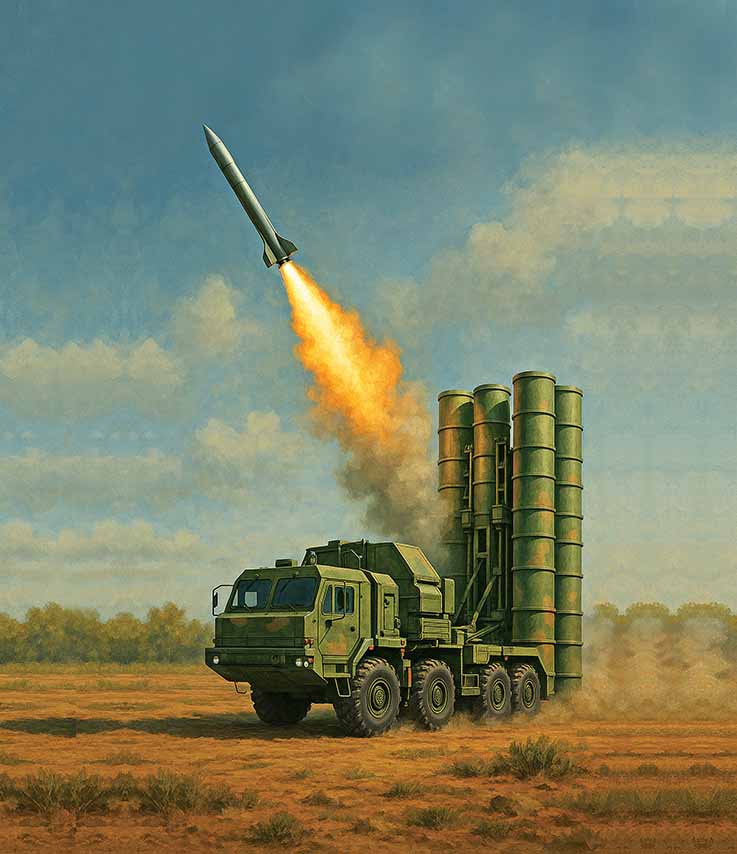
Developed by Russia’s Almaz-Antey, the S-400 Triumf is a mobile, surface-to-air missile system capable of engaging a wide spectrum of aerial threats, including fighter jets, drones, ballistic and cruise missiles at ranges up to 400 km and altitudes reaching 30 km. Known to be built on heavy-duty Russian trucks MAZ-543 or its variant MAZ-7910 by Minsk Automobile Plant (MAZ), Belarus, these are offered in 8×8 configurations and carry launchers, radar and a command post of the S-400 system. Also on additional platforms like the BAZ-6402 or BAZ-6909 series by Bryansk Automobile Plant due to their off-road capabilities and localised production. The KAMAZ chassis offers support and auxiliary systems in some configurations. Capable of simultaneously tracking and engaging up to 80 targets, it offers layered defence by deploying multiple missiles tailored to different types of threats. India finalised a USD 5.43 billion agreement with Russia in 2018 to acquire five squadrons, resisting U.S. sanctions threats under CAATSA. The delivery began in 2021, and select squadrons are now operational along both the western and northern borders, covering Pakistan and China,
Why ‘Sudarshan Chakra’?
The term ‘Sudarshan Chakra’ underscores the S-400’s rapid, rotational radar system and surgical strike capability. Much like the divine weapon that never missed its mark, the S-400’s ability to preemptively detect, track, and destroy hostile targets before they reach Indian airspace offers an immense strategic edge. For adversaries contemplating air-based incursions, especially during periods of tension, the S-400 is a strong deterrent. In the event of hostile aircraft mobilising near the border, the Indian Air Defence Command can intercept them well before they become a threat, as shown during the ongoing engagements. The system forms the uppermost layer of India’s multi-tier air defence grid, working in tandem with lower-range systems like the Akash, SPYDER, and Barak-8.
The AERIAL Shield
During the classified but widely discussed Operation Sindoor, which involved high alert posturing along the western front amid heightened Indo-Pak tensions, it wasn’t just the S-400 that ensured dominance in the skies. Systems like the Akash Surface-to-Air Missile (SAM) are known to have proved instrumental in safeguarding key border installations and air bases. Akash, an indigenously developed all-weather missile system with a range of 25–30 km, intercepted multiple aerial threats during coordinated live drills. Alongside the S-400, Akash played the role of a frontline quick-reaction shield, proving its mettle in close-to-border deployments and underscoring the robustness of India’s layered defence doctrine. Together, these systems showcased India’s ability to neutralise threats from both high and low altitudes across variable engagement zones.
Deterrence Through Technology
Beyond tactical superiority, the S-400 symbolises a strategic deterrent. In volatile regions like South Asia, where flash points can escalate rapidly, India’s capability to maintain air dominance reduces the chances of miscalculation by adversaries. Equally important is the S-400’s role in integrated network-centric warfare. It can interface with India’s indigenous surveillance grid, including AWACS, satellites, and radar networks. This inter operability allows India to build a unified air situation picture, ensuring real-time threat assessment and coordinated defence responses.
While India’s defence upgrade is commendable, integrating such advanced systems into the broader command and control infrastructure requires time, training, and logistical preparedness. Ensuring uninterrupted serviceability, especially in harsh terrains and in the face of electronic warfare threats, remains a key challenge. There is also the cost factor! Aware of the shift, Pakistan has reportedly begun evaluating low-altitude cruise missiles, terrain-hugging drones, and EW systems. However, the consensus among military experts is that India has established a clear edge.
Holding the Sky
The induction of the S-400 Triumf, backed by indigenous platforms like Akash, is emblematic of India’s shift from reactive to proactive defence. These systems ensure that while diplomacy remains the first line of resolution, deterrence is layered, potent, and technologically superior. In the era of rapid geopolitical shifts and hybrid warfare, India’s ‘Sudarshan Chakra’ ensures that its skies are not just protected, they are sovereign, watched, and ready.






Leave a Reply